

Roughly two out of every three Florida homeowners are still making payments to a bank. So the question I hear most at kitchen tables across this state isn’t about price. It’s about permission: can you sell a house with a mortgage in Florida without the bank blocking the whole thing? You can. Closings in Florida handle this every single business day, and the mechanics are far more ordinary than the worry suggests.
Can You Sell a House with a Mortgage in Florida?
A retired couple in Port St. Lucie called me convinced they were trapped because they’d refinanced in 2021 and barely dented the principal. Their loan officer had told them something vague about “payoff restrictions,” and they’d spent four months believing it.
Nothing in Florida law stops you from selling a house with a mortgage. A lien, not ownership, is held by the lender. The deed bears your name, so the bank just has a recorded claim that has to be cleared before clean title passes to a buyer. Clearing it is the title company’s job, and it happens inside the closing itself.
Last year I worked with a young couple in Deltona who’d watched two agent listings expire without a single offer. Their three-bedroom had a converted garage the appraiser kept flagging, so they were still paying a mortgage on a house nobody would write a contract on. We closed in under three weeks with the loan paid off at the table.
Timing matters here. Statewide, Florida’s median single-family price hit $420,000 at the end of October 2026, a 2.2 percent increase over the prior year. Inventory sat at a 4.6-month supply that month, the highest since May of 2026, so buyers take their time, and a seller carrying a payment feels every extra week.
Does that mean you should panic-sell? No. It means you should know your numbers before you list, which is where most people go wrong.
How Does Selling a House with a Mortgage Work in Florida?
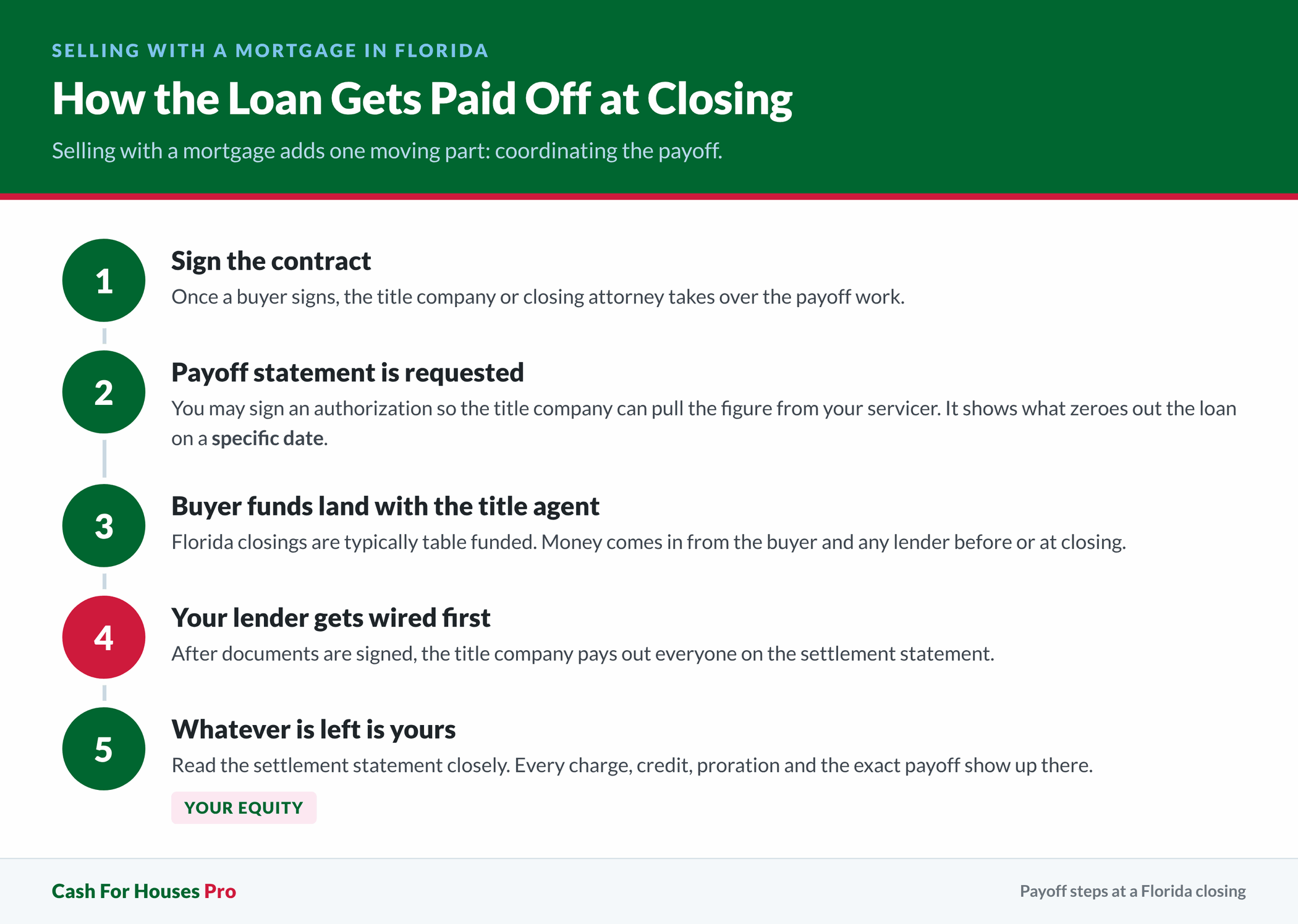
Picture the closing table and work backward from it, because that’s where the loan actually dies.
Once you’ve got a signed contract, the title company or closing attorney requests a payoff statement from your servicer. You may have to sign an authorization letting them pull that information from the mortgage servicer on your behalf. That document states what it takes to zero out the loan on a specific date, not what your app showed last Tuesday.
Buyer funds land with the title agent before or at closing. Closings in Florida are typically table funded, which means money comes in from the buyer and any lender, then the title company disburses to everyone listed on the settlement statement once the documents are signed. Your lender gets wired first. Whatever’s left is yours.
The settlement statement is the document to read carefully. Every charge, credit, and proration shows up there in black and white, including the exact payoff figure going to your lender.
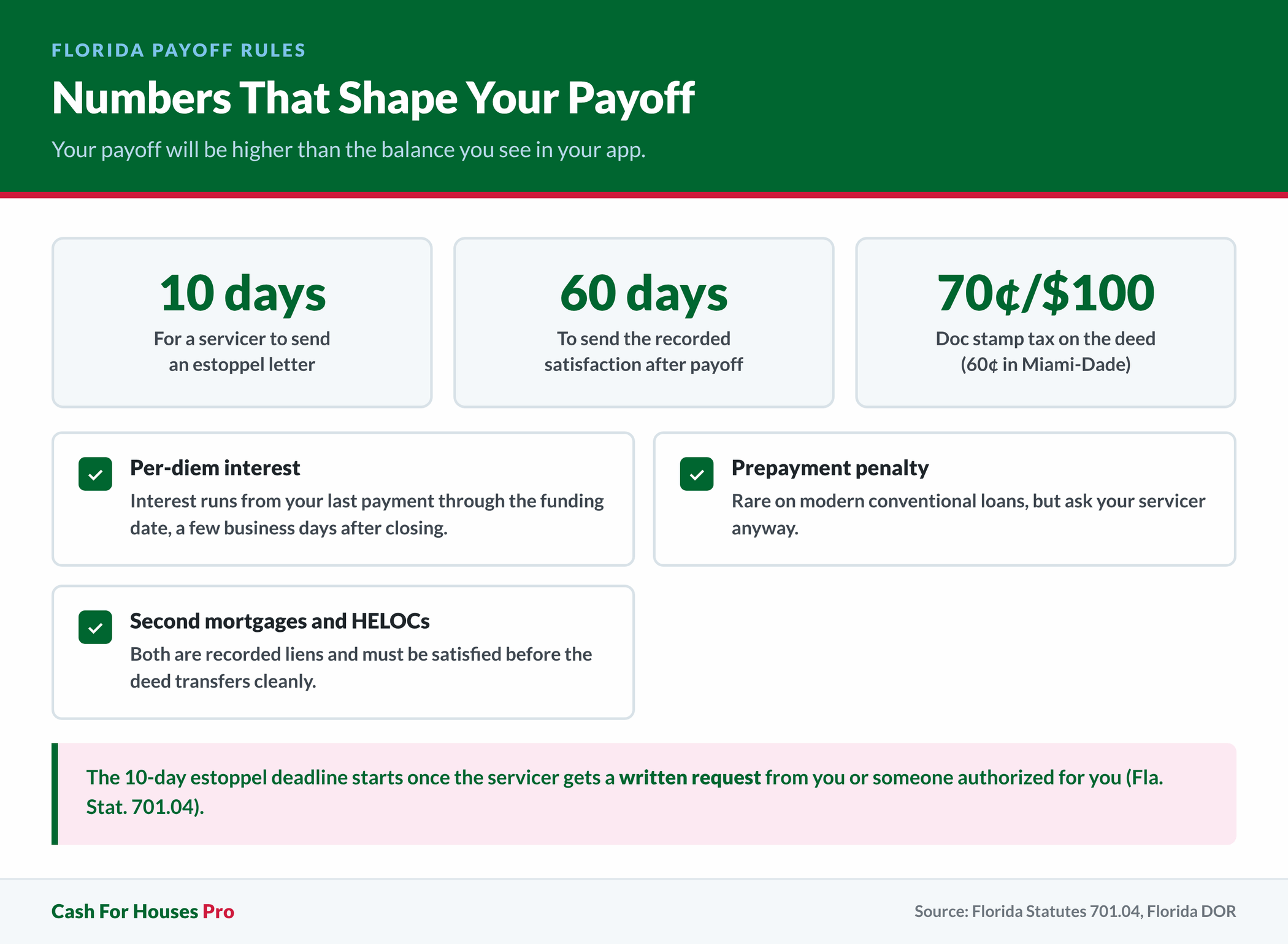
Sellers in Florida also deal with documentary stamp tax on the deed. The Department of Revenue sets that at 70 cents per $100 of total consideration in every Florida county except Miami-Dade, where the rate drops to 60 cents per $100. Contract terms decide who writes that check, so sellers end up carrying it in most Florida deals.
Selling a house with a mortgage adds exactly one moving part to a normal sale: coordinating the payoff. That’s it. I’d rather sellers spend their worry on the inspection than on the loan.
What Happens to Your Mortgage Balance When You Sell in Florida?
So will you still owe money on closing day? Yes, and that payoff number will be higher than the balance you’ve been staring at all year. The payoff includes per-diem interest running from your last payment through the funding date, which usually lands a few business days after closing, plus any prepayment penalty the loan carries. Prepayment penalties are rare on modern conventional loans, but I still tell every seller to ask anyway.
The law in Florida gives you a right to that figure in writing. Under the 2025 version of Florida Statutes section 701.04, a mortgagee or servicer must send an estoppel letter stating the unpaid balance within 10 days. This applies after receiving a written request from you or someone authorized to act for you. You’re never stuck guessing. You can read the section yourself at the Florida Senate’s statute database.
After the money moves, the lien has to come off the public record. That same chapter requires the party acknowledging satisfaction to send the recorded satisfaction to whoever made the full payment within 60 days of receiving it. Until that satisfaction hits your county’s official records, the mortgage still shows as a live lien against the property.
A second mortgage or a HELOC gets the same treatment. Both are recorded liens, so both must be satisfied before the deed transfers cleanly. Home equity lines surprise people because the draw balance fluctuates, so the payoff can differ from what you assumed when you last logged in.
What if you owe more than the house will bring? That’s a short sale, a different animal, and it needs lender approval before closing. Selling a house with a mortgage that’s underwater is possible in Florida; it just takes longer and the bank gets a vote.
How Do You Calculate What You’ll Owe When Selling with a Mortgage?
“My agent already gave me a net sheet.” Good, and I’d still run it again yourself, because net sheets prepared before a contract exists tend to use round numbers for things that aren’t round.
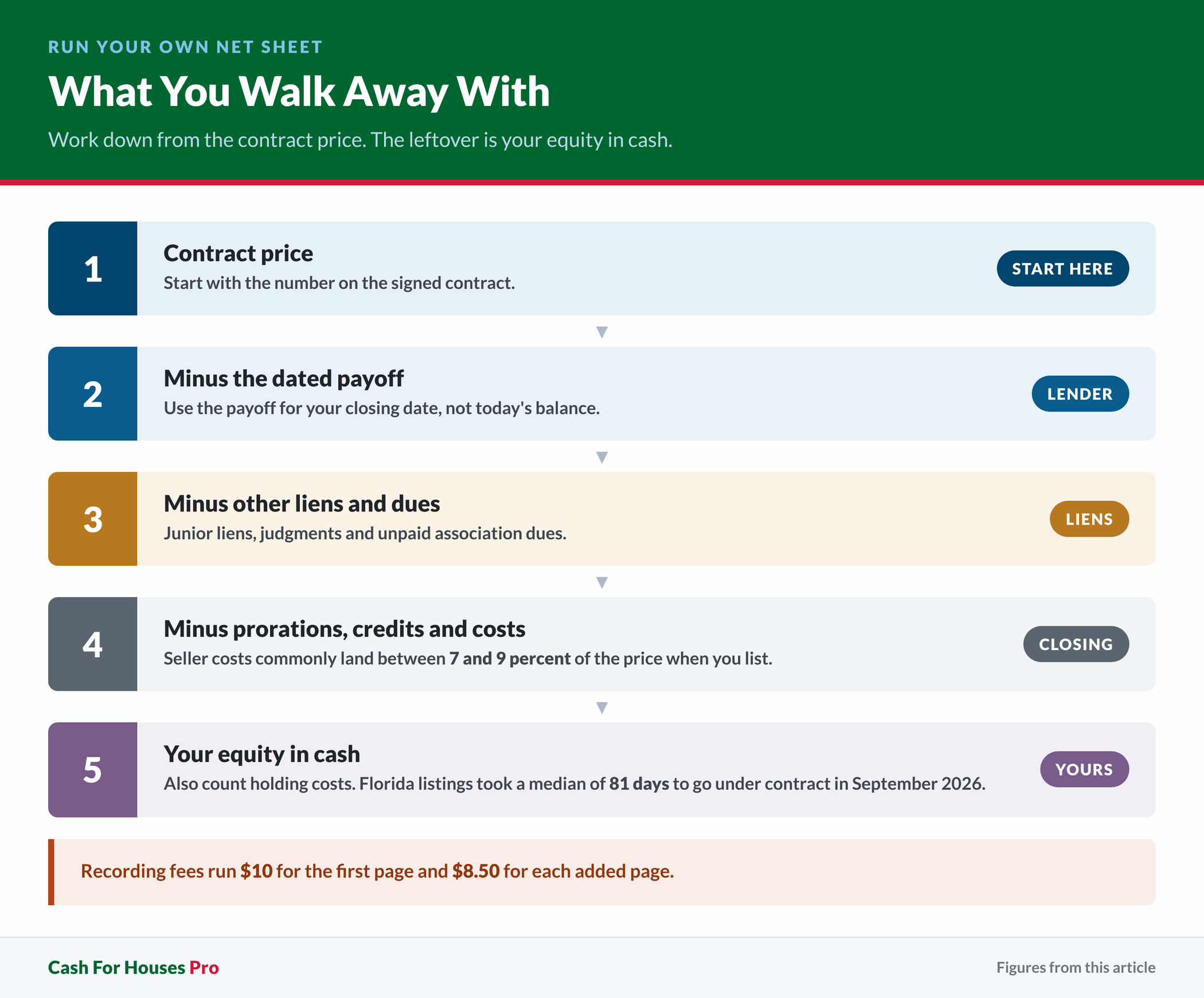
Start with the contract price. Subtract the dated payoff, then any junior liens, judgments, or unpaid association dues. Prorations, agreed credits, and whatever closing costs the contract assigns to the seller come off next. The leftover is your equity in cash form.
When you list, commission dominates the cost side. Seller costs in Florida commonly land between 7 and 9 percent of the price once brokerage fees, doc stamps, and title charges are counted. Run that against the Florida market and the number gets real: on a sale near the statewide median, you’re handing over roughly thirty thousand dollars before your lender takes a dime.
Recording charges are smaller but real. Florida recording fees run $10 for the first page and $8.50 for each additional page, which covers getting your satisfaction of mortgage and the new deed into the county record.
Then there’s holding cost, the line nobody puts on a net sheet. Florida listings took a median of 81 days to go under contract in September 2026, and about 20 percent of them had a price cut, so closing time stacks on top of that. Four or five more mortgage payments, plus insurance and taxes, is the honest cost of a traditional listing in Florida right now.
I’ve watched sellers chase an extra fifteen thousand in list price and spend twelve thousand waiting for it. The math on speed is worth doing before the math on price.
Do I Need to Tell My Lender I’m Selling My House with a Mortgage?
Your servicer usually finds out when the title company requests the payoff, not when you make the decision. There’s no notification form, no permission slip, no approval step for a standard sale where the loan gets paid in full.
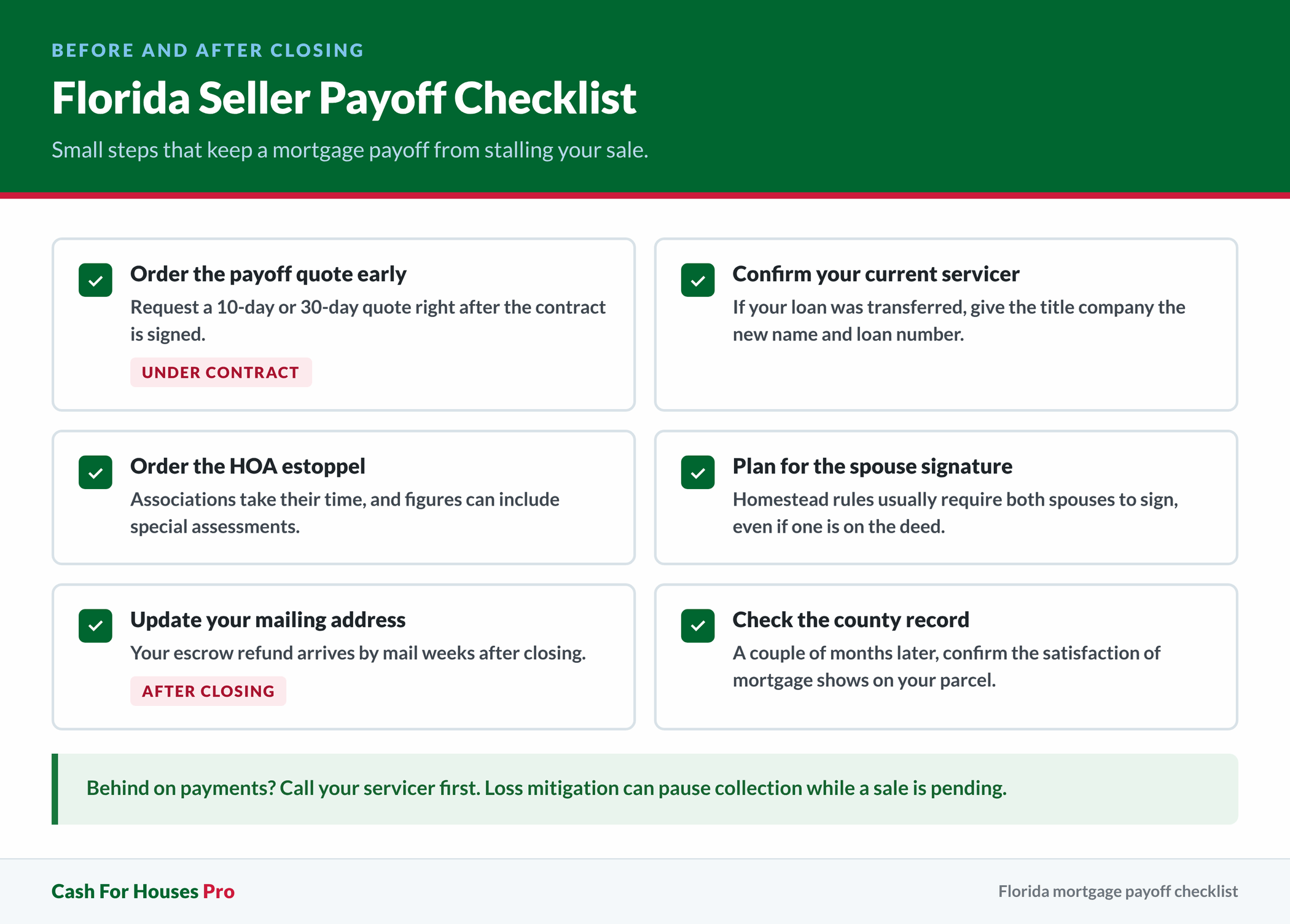
Call them anyway, early. Order the payoff quote as soon as you’re under contract, because servicers are slow and a delayed letter stalls a closing. A 10-day or 30-day payoff quote requested right after contract signing keeps the number current through your closing date.
Escrow is the piece that sellers forget. If your Florida lender has been collecting for property taxes and that insurance premium that keeps climbing, the escrow balance doesn’t vanish into the payoff. Your servicer refunds it, usually by mail, weeks after closing. I’ve seen homeowners move out of state and never update the address, then wonder where that check went.
Have you told your lender yet, or are you waiting until the contract’s signed? Waiting is fine. Forgetting to request the payoff is not.
One more thing on selling a house with a mortgage in Florida: if you’re behind on payments, call the servicer before anyone else. Loss mitigation departments can pause collection activity while a sale is pending, but only if they know a sale exists. Silence gets you nothing.
Can You Roll Your Mortgage Into a New Florida Property?
Get this wrong and you end up making two payments on two houses in a state where carrying costs are nobody’s friend.
Your mortgage doesn’t travel. It’s secured by a specific parcel described in the recorded documents, and that parcel is the house you’re selling. The old loan dies at closing, and buying in Naples or Jacksonville or anywhere else means originating a new home loan with current mortgage rates and current underwriting.
What does move is your equity. Proceeds from selling a house with a mortgage in Florida become the down payment on the next one, which is why timing the two closings matters so much.
Porting exists in other countries. American mortgage lenders don’t generally offer it. A few government-backed loans are assumable, meaning a qualified buyer can take over your existing loan and its interest rate. But assumption transfers the loan to a buyer; it doesn’t transfer your loan to your next house. FHA and VA loans are the common candidates, and your servicer decides whether a specific buyer qualifies.
Bridge financing fills the gap for some sellers, letting you buy before you sell. Costs more. Works when the numbers support it.
Simultaneous closings are the cleaner path, and Florida title companies coordinate them regularly, so you’re not stuck waiting between the two. Sell in the morning, buy in the afternoon, same settlement agent handling both files. Your payoff clears on one deed, your funds roll straight into the next.
What Should Florida Sellers Know Before Paying Off Their Mortgage?
“Will I owe taxes on this?”
Most sellers won’t. The federal exclusion on capital gains from a primary residence shields a large chunk of profit if you’ve owned and lived in the home for two of the last five years. Details and current figures live at the IRS page on selling your home. A CPA is worth an hour of your time if you’ve got rental history or a big gain.
Watch the satisfaction recording. Pull your county clerk’s online records a couple of months after closing and confirm the satisfaction of mortgage shows up against your parcel. Lenders miss this more often than you’d like. An unreleased lien surfaces years later when somebody runs title.
Condo and HOA sellers have an extra layer. The association’s estoppel letter sets what you owe through closing, and those figures sometimes include special assessments you forgot about. Order it early; associations take their time.
Florida’s market is not uniform, and your payoff math shifts with geography. From October 2025 through September 2026, the median home in Broward County took 51 days to sell and 45 days in Palm Beach County. Orlando’s median single-family sale price was $441,500 in October 2026. A seller in Winter Park and a seller in Cape Coral are solving different problems with the same loan.
If repairs stand between you and a clean payoff, selling as-is is a legitimate answer, not a surrender. Teams like Cash For Houses Pro buy Florida houses in whatever condition they’re in and handle the payoff coordination through title the same way any buyer would.
Is Selling a House with a Mortgage More Complicated in Florida?
A woman in Lehigh Acres reached out about her late father’s house, three months behind on the mortgage with an auction date already on the calendar. The garage was full of his fishing gear and a boat trailer nobody had moved in years, and she’d assumed the bank already owned the place.
It didn’t. A homeowner in default still holds title until a foreclosure sale happens, and selling a house with a mortgage in that position is possible right up to the sale date. We coordinated the payoff with her servicer’s loss mitigation group and closed with days to spare.
Florida adds a few wrinkles other states don’t have. Deeds here require the seller’s signature, a notary, and two witnesses. Doc stamps get calculated on the deed. Hurricane season affects insurance binders and sometimes delays closings outright, and condo buildings statewide now face structural reserve requirements that complicate financed sales.
Is any of that harder than a normal sale? Not really. Florida title companies do this constantly, and the payoff process is standardized across all 67 counties even when office procedures differ. The Florida Department of Revenue publishes the deed tax rules at floridarevenue.com if you want the official source.
Complication comes from the situation, not the loan. Probate, divorce, tenants, code violations, deferred maintenance: those are the things that stretch a Florida closing, and I’ve seen any one of them add weeks by itself. An ordinary mortgage on an ordinary house is a non-event at the table.
Frequently Asked Questions About Selling a House with a Mortgage in Florida
What Happens If My Lender Sells My Mortgage to Another Company?
Nothing about your ability to sell changes. Loans get transferred between servicers constantly, and the new servicer inherits the same obligations the old one had, including issuing a payoff statement on request. Make sure your title company has the current servicer’s name and your loan number, because sending a payoff request to the old company wastes a week you may not have.
Can I Sell a Florida House If I’m Behind on Payments?
Yes, as long as a foreclosure sale hasn’t happened yet. You still hold title, and the sale proceeds can bring the loan current or pay it off entirely. Tell your servicer a sale is in progress, since loss mitigation departments can sometimes hold off on further action while a contract is pending.
How Long After Closing Does My Mortgage Lien Come Off the Record?
Your lender has a statutory window after receiving full payment to record the satisfaction and send you a copy, as described earlier in this article. Most servicers handle it well inside that window, but checking your county clerk’s records yourself is the only way to be certain it happened.
Will I Get Money Back From My Escrow Account?
You should. Escrow funds collected for taxes and insurance belong to you, and the servicer refunds the remaining balance separately from the closing proceeds. Confirm your mailing address with them before you move, because that refund arrives weeks after everyone else has been paid.
Do I Need My Spouse’s Signature to Sell a House with a Mortgage in Florida?
Probably, even if only one of you is on the deed. Florida’s homestead protections generally require both spouses to join in conveying homestead property, and your title agent will flag it during the title search. Trying to work around it stalls the closing.
Is a Cash Sale Faster When There’s Still a Mortgage on the Property?
Usually, yes. Removing a buyer’s lender takes underwriting and appraisal out of the timeline, though your own payoff still has to be ordered and wired through the closing agent. The savings come from the buyer’s side of the transaction, not from skipping your loan.
What If the Payoff Is More Than the Sale Price?
Then you’re looking at a short sale or bringing cash to the table. Lenders review short sale requests case by case, and approval takes considerably longer than a standard Florida closing. Start that conversation with your servicer before you accept any contract.
If you’re sitting on a Florida house with a loan on it and you’re not sure whether listing, waiting, or selling direct makes the most sense for your situation, we’re glad to talk it through. Bring your payoff estimate and your timeline, and we’ll give you a straight read on your options, including the ones that don’t involve us. No pressure, no obligation, and no hard sell if traditional is the better move for you.
Selling a House With a Mortgage in Tampa Bay
Tampa Bay is home base for Cash For Houses Pro, and the payoff steps above work the same way here as anywhere in Florida. Florida Realtors data puts the Tampa-St. Petersburg-Clearwater single-family median at $405,495 for October 2026, up 1.6 percent from a year earlier. Steady prices give you room to plan your payoff instead of rushing it. Run your own net sheet first, then decide whether listing or a direct sale leaves you with more.
Talk Through Your Florida Payoff With Cash For Houses Pro
Wondering how your payoff, your equity, and your timeline fit together? Reach out to Cash For Houses Pro and we’ll walk through the numbers with you. If a cash offer makes sense for your house, we’ll explain how it would work. If listing makes more sense, we’ll tell you that too. You can also fill out the short form below.