

A home inspection has never been required by law for a residential sale in this state, so that single fact tends to relieve more stress than almost anything else I tell a homeowner. I’ve been buying houses here long enough to watch it happen over and over. Selling without inspection is legal in Florida, and it happens every single week, from Pensacola condos to Homestead bungalows.
What Does It Mean to Sell a House Without Inspection in Florida?
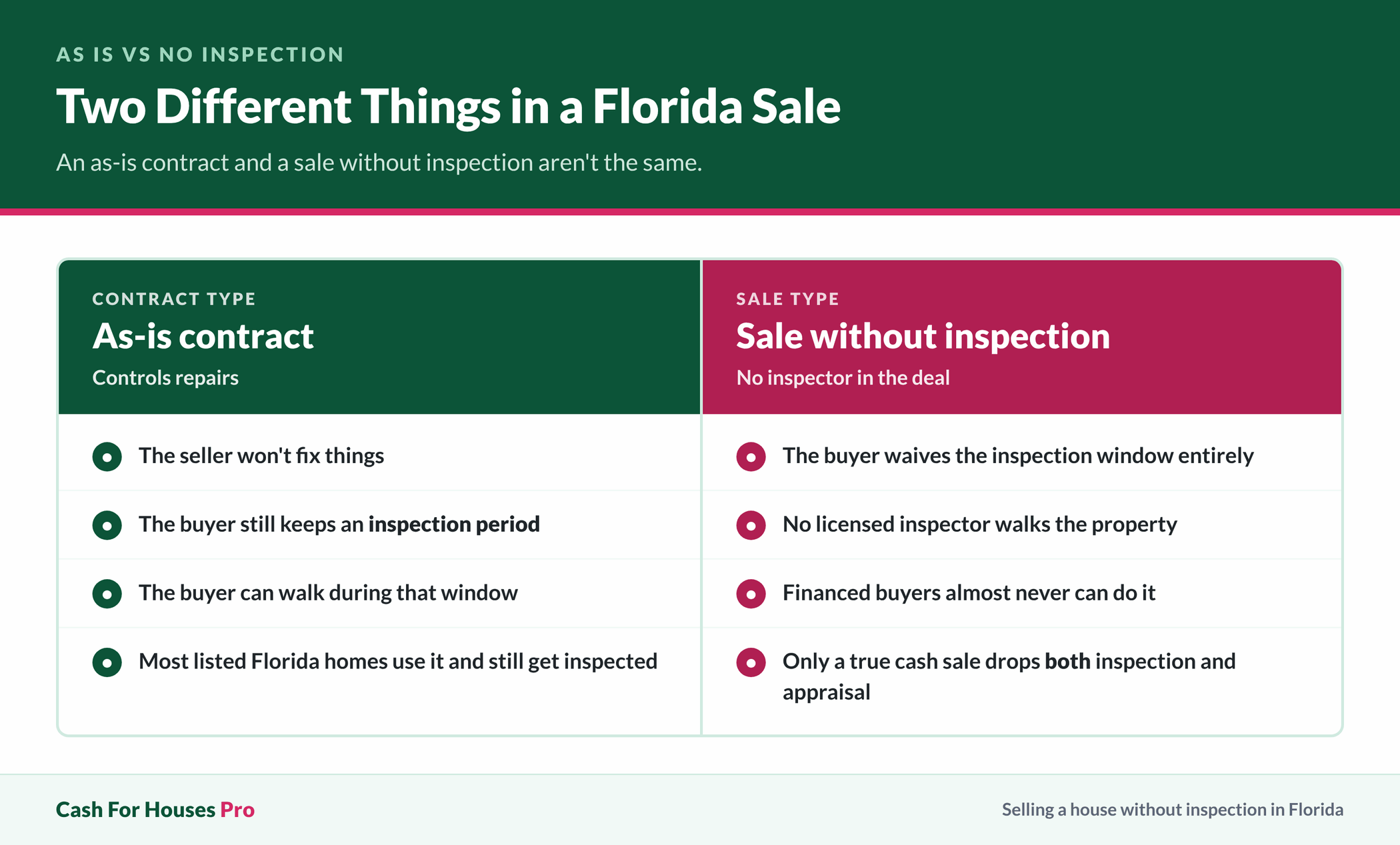
An “as is” contract and a sale without inspection are two different animals, and the standard Florida Realtors/Florida Bar form keeps them separate. Repairs fall under the as-is language. Selling this way means no licensed inspector ever walks the property during the deal.
Most listed Florida homes use an as-is contract and still get inspected, because the buyer keeps an inspection period to back out. An as-is contract controls repair obligations, so the seller won’t fix things, and the buyer can walk during the inspection period.
When you sell a house this way, the buyer waives that window entirely. They look at the property, run their own numbers, and sign without a third-party report, though financed buyers almost never can since the lender wants eyes on the collateral.
Does that mean nobody looks at your house at all? No. I still walk a property before I write an offer, and so does every serious investor in this market, because that difference matters: my walkthrough isn’t a contingency you can fail.
Sellers in Florida choose this route for one reason above all others: certainty. A contract with no inspection has fewer moving parts and fewer exit ramps.
One correction I make constantly at kitchen tables: skipping the inspection does not skip the appraisal when a mortgage is involved. Those are separate reports with separate purposes. A home appraisal protects the lender’s money; an inspection protects the buyer’s expectations. Only a true cash sale drops both.
Is It Legal to Sell a House as Is Without Inspection in Florida?
Under Florida law, a pre-sale inspection on a residential property isn’t required, so a sale without one breaks nothing. What can create liability is staying quiet about a defect you already know about, which is a disclosure question, not an inspection question.
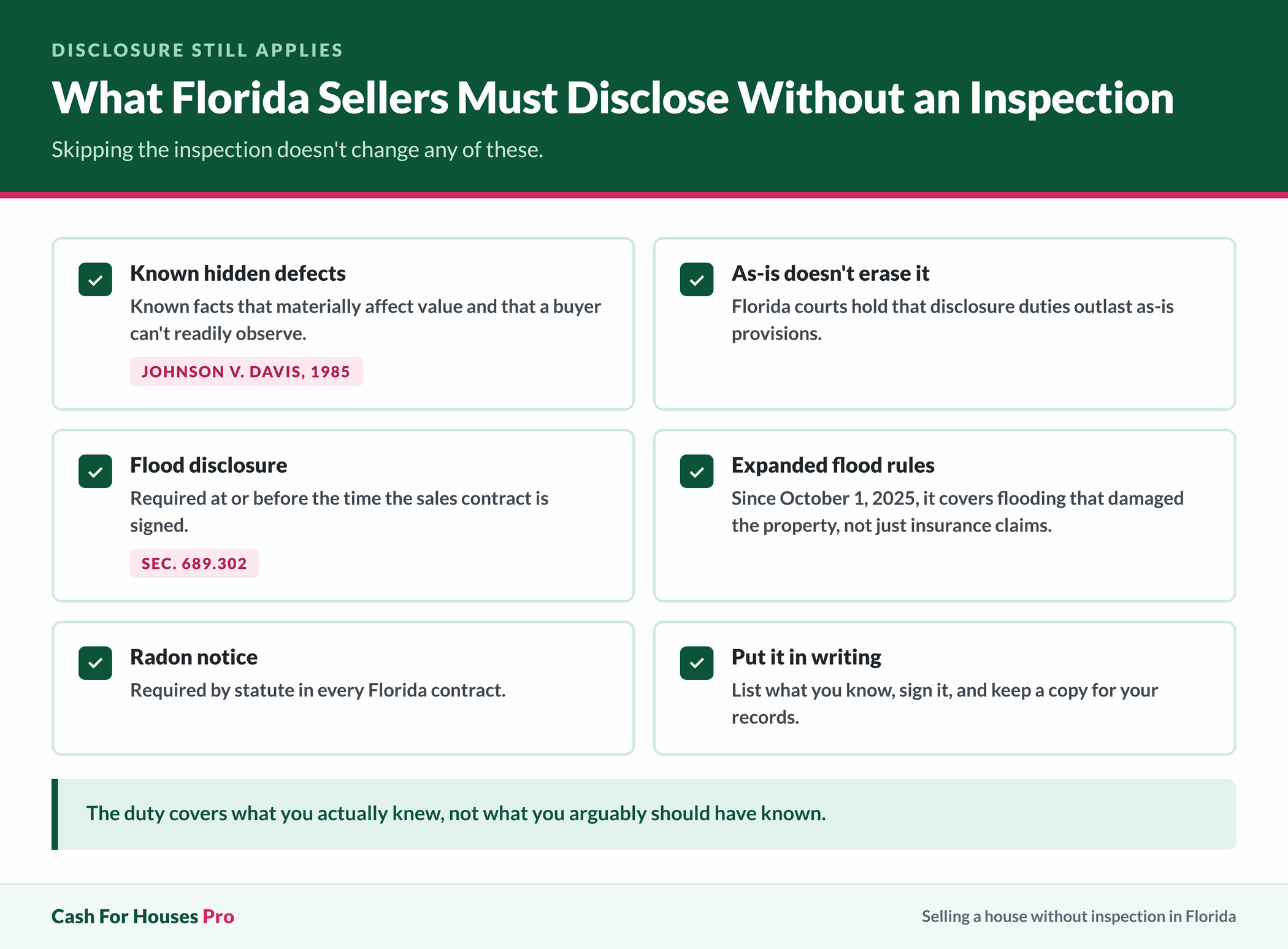
Four decades ago, Florida ended buyer-beware for homes. Under the Johnson v. Davis standard, a seller here has to disclose known facts that materially affect the property’s value and that a buyer can’t readily observe. The rule came from the Florida Supreme Court in 1985, and it covers every residential sale in the state, as-is contract or not.
The obligation attaches to what a seller genuinely knew, not to what they arguably should have known. For anyone selling this way, that distinction matters enormously, because you can’t be expected to reveal something no one ever discovered.
You also aren’t forced onto one government form in Florida. State law doesn’t mandate a single official disclosure document, though most sellers use the standard Seller’s Property Disclosure to show they complied. Attorneys put it bluntly: these obligations come from law rather than contract language, so the parties can’t simply opt out of them.
So yes, selling your Florida house this way is completely lawful. Just tell the truth about what you know, in writing, and keep a copy.
Why Would a Florida Home Seller Skip the Inspection?
A retired couple in St. Petersburg called me last year after quietly carrying two mortgages for almost eleven months. They’d bought near family up north, the Florida house didn’t sell, and the garage still held the husband’s half-finished boat restoration project they couldn’t face moving. Two payments a month will exhaust anyone.
Listing pace in this state has stretched out, and I’ve watched sellers get frustrated waiting it out. Statewide, homes sat a median of 81 days in September 2026, down eight percent from a year earlier, and about 20 percent of listings took a price cut that month. Add the inspection period, the repair negotiation, and the lender’s timeline on top of that, and a listed sale can eat four or five months.
Then there’s the condition of the place. Older Florida housing stock carries roof age issues, 1970s electrical panels, polybutylene plumbing, and the occasional surprise under a bathroom floor. A seller who already knows the roof is past its service life doesn’t need a report confirming it. They need an offer priced with that in mind.
Inherited properties push people toward a sale that skips it too.
And landlords selling tenant-occupied units often skip it simply because scheduling access for an inspector means coordinating with someone who has no reason to cooperate. Why create that friction when a buyer is willing to purchase as is?
Do Florida Disclosure Laws Still Apply Without an Inspection?
Get this part wrong and a buyer can unwind your closing or come after you for the repair cost.
The disclosure duty survives every as-is clause your contract contains. Florida courts have ruled consistently that these duties outlast as-is provisions, because the clause speaks to warranty obligations rather than to the disclosure requirements the law imposes. Selling without inspection changes nothing about that.
There’s also a statutory form you can’t skip. Section 689.302 of the Florida Statutes requires a seller to complete and give a flood disclosure to a buyer of residential real property at or before the time the sales contract is executed. October 1, 2024, marked the effective date of that requirement. An expanded version of the statute took effect October 1, 2025. It added the seller’s knowledge of any flooding that damaged the property during their ownership, not just flooding that triggered an insurance claim. In a state that saw what the last few hurricane seasons did, that change has teeth. You can read the statute text yourself at the Florida Legislature’s site.
Florida also requires a radon notice. That disclosure is required by statute in every contract.
Write down the water intrusion from the 2022 storm. Also mention the permit you never closed out on the lanai. Disclosure costs you nothing when you’re already selling without inspection at an as-is price, and omitting it is the only way this route genuinely hurts you.
What Are the Risks of Selling a Florida House Without Inspection?
You’re probably leaving a little money on the table, and you should decide on purpose whether that trade is worth it to you.
A buyer who waives inspection is absorbing unknowns, and they price those unknowns in, so the discount they’re asking for is real. It’s usually smaller than sellers fear and larger than buyers admit, which is exactly why the number deserves scrutiny rather than a shrug.
Thin buyer pools create the second risk. Financed purchasers mostly can’t proceed without inspection, so you’re working with cash investors and a handful of renovation-loan buyers.
The third risk is the one I’d flag hardest: a lowball offer dressed up as convenience. Some operators in Tampa and Jacksonville quote a number, tie you up under contract, then “discover” problems and reprice the deal a week before closing. That’s not selling without inspection; that’s a late inspection with extra steps. Ask any buyer, including us at Cash For Houses Pro, whether their offer can change after you sign, and get the answer in writing.
Title problems don’t disappear either. An open permit, a contractor’s lien, or a sibling who never signed off on an inherited deed will stop a closing regardless of inspection status.
Should you worry about getting sued later? Only if you concealed something. Buyers pursuing a nondisclosure claim carry a real burden: they have to prove the seller actually knew about the defect they’re complaining about.
What Are the Benefits of Selling as Is Without Inspection?
Which brings up the other side of that ledger, where the advantages are concrete rather than theoretical. Speed leads the list. A sale without inspection removes the single most common reason Florida deals collapse between contract and closing.
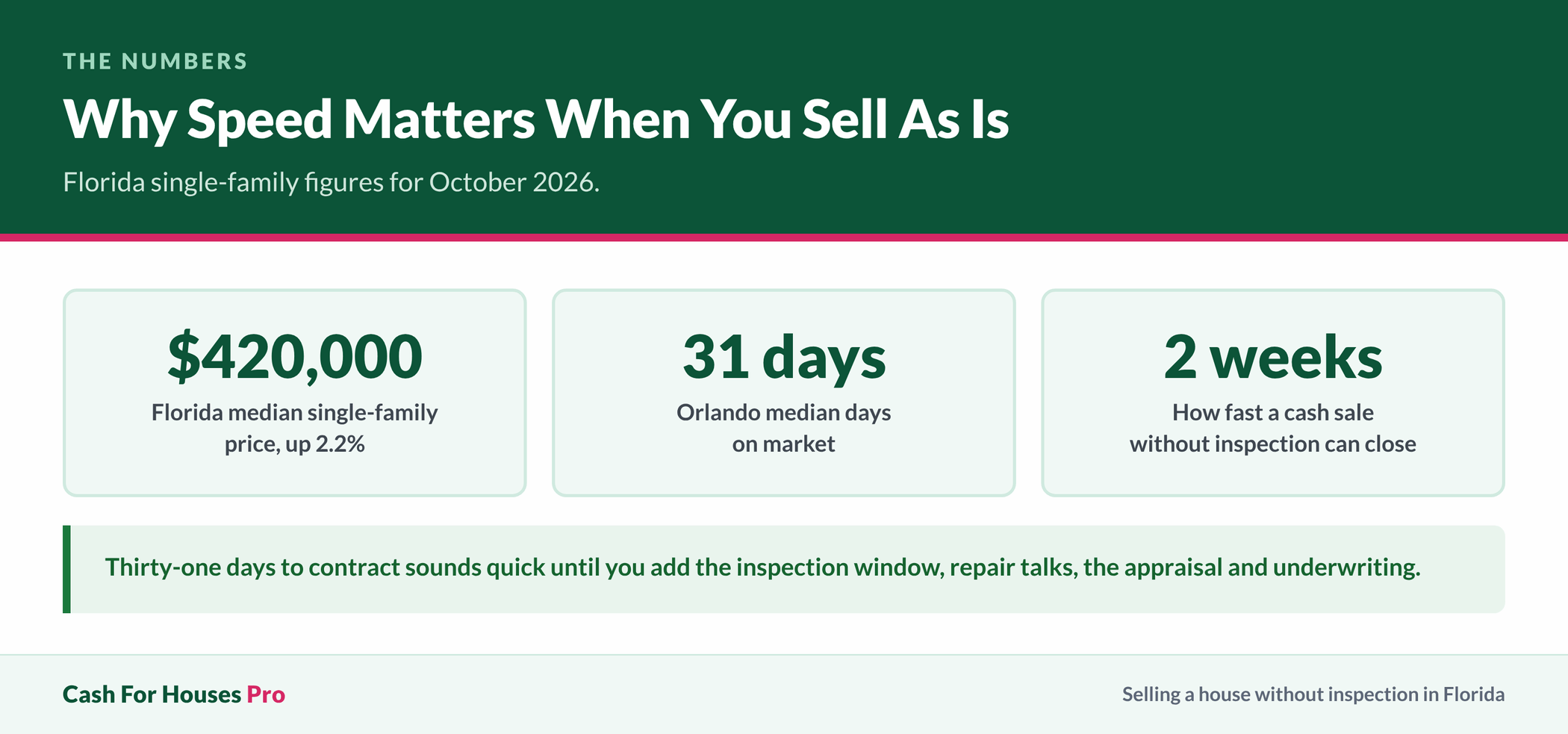
The numbers tell the real story. In Orlando, the median single-family sale price was $441,500 in October 2026, with homes carrying a median of 31 days on market and 4.2 months of supply. Thirty-one days to contract sounds quick until you add the inspection window, the repair back-and-forth, the appraisal, and underwriting. A cash sale without inspection can close in two weeks.
No repair spending is the second benefit, and sellers usually underestimate it. Every dollar you sink into a roof or an AC unit before listing is a dollar you may not recover, especially on an older property.
Statewide pricing supports the as-is seller better than it did a few years back. Florida’s median single-family price at the end of October 2026 was $420,000, a 2.2 percent year-over-year increase, and inventory rose to a 4.6 month supply, the highest since May 2026. Equity is still there in most Florida neighborhoods, even on houses that need work.
Privacy deserves a mention too. No lockbox, no weekend showings, no strangers opening your closets.
What Happens When You Sell to a Cash Buyer Without Inspection?
Most people want to know exactly what happens next and when, and the ones selling without inspection want that more than anyone.
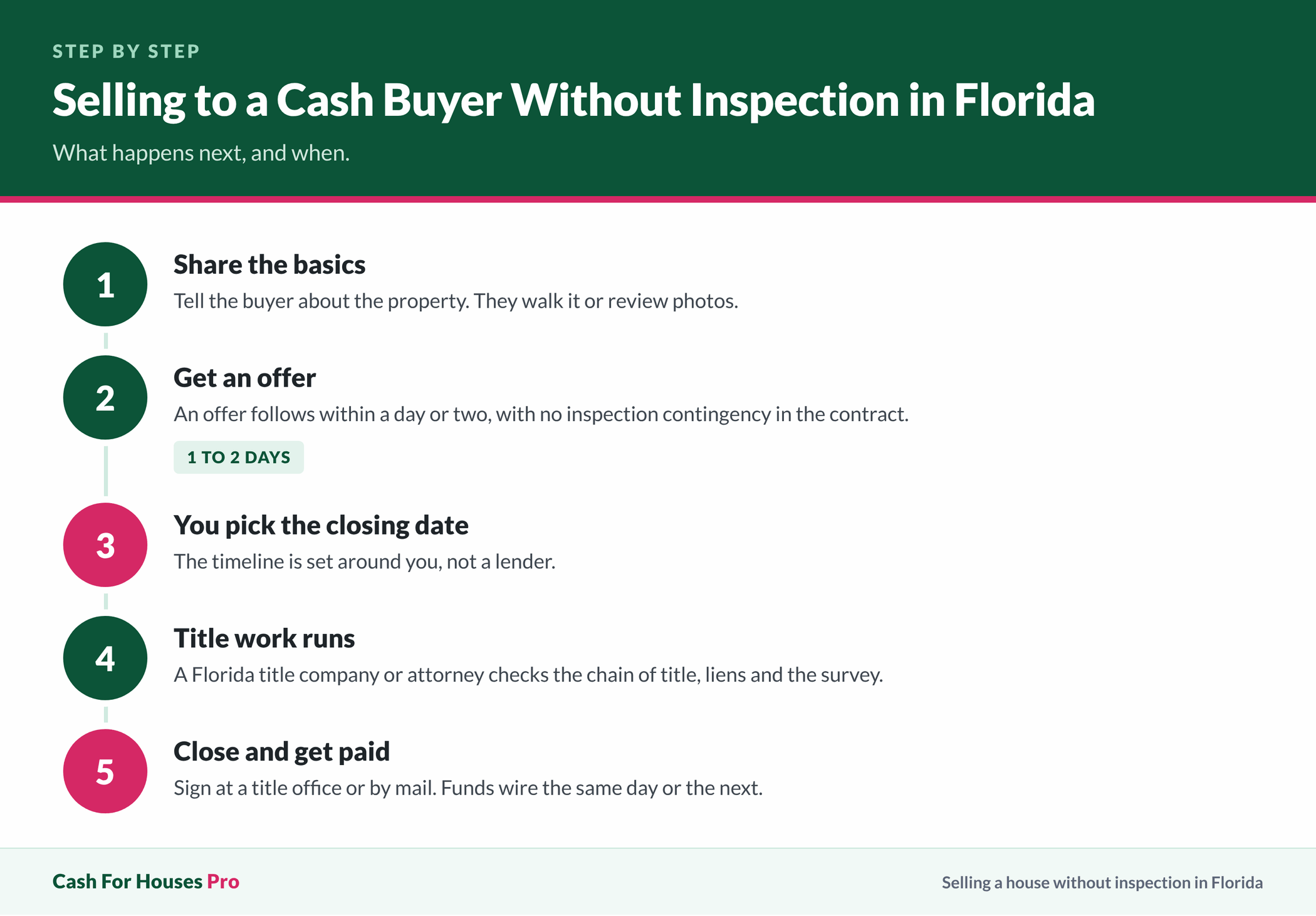
Here’s the actual sequence with a legitimate cash buyer in Florida. You share the basics about the property, we walk it or review photos, and an offer follows within a day or two. No inspection contingency appears in the contract. You pick the closing date.
Title work runs in the background. A Florida title company or real estate attorney pulls the chain of title, checks for liens, confirms the survey, and prepares the closing documents.
Closing happens at a title office or by mail. You bring ID, you sign, and funds wire the same day or the next.
What should you ask a cash buyer before signing? Three things: whether they’re purchasing directly or assigning the contract to someone else, whether the price can change, and whether they can show recent Florida closings. Honest answers to those come easily.
Price expectations need to stay grounded. A cash offer skipping that step reflects repair costs, holding costs, and resale risk. On a Fort Myers house needing a roof and a kitchen, that gap is meaningful; on a tidy Ocala ranch, it narrows considerably. Anyone promising retail money for a distressed property without one is setting up a renegotiation later.
How Do You Sell a House Without Inspection Successfully in Florida?
Waiving the inspection isn’t the whole plan. Sellers who stop there often take the first offer and then learn the buyer never had the money. You still have to prepare. It just looks different from prepping a listing.
Start with your paperwork: deed, mortgage payoff, tax bill, insurance claim history, permits and any HOA documents. A Florida closing only moves as fast as its slowest document.
Put your disclosures in writing before any offer comes in. Listing what you know protects you and keeps surprises out of the closing. Your duty doesn’t end at signing, either. If a buyer asks questions later and you give false or incomplete answers about known defects, that can still support a claim.
Get two or three cash offers. Comparing them shows what your house is worth as-is better than any estimate, and Florida has plenty of buyers who skip inspections. Ask each buyer for proof of funds. A bank statement or a letter from their bank takes one email to request. Buyers who stall are often shopping your contract to someone else.
One Winter Haven owner called us after moving her father into assisted living two counties away. The pool hadn’t been used in three years, and the mailbox was full of unopened insurance notices. We closed in seventeen days. She kept two pieces of furniture.
Most people selling without inspection here are carrying something heavy. A cash sale with clear disclosures and a buyer who sticks to their first number is a smart way through it. Cash For Houses Pro works with Florida sellers in that spot every month.
Frequently Asked Questions About Selling a House as Is Without Inspection in Florida
Can a Buyer Still Cancel the Contract If I Sell Without Inspection in Florida?
It depends entirely on what the contract says. When a buyer waives the inspection contingency, they give up that specific escape route, but other contingencies like financing or title can still allow cancellation. Read the contract before you sign and ask your title company or attorney to point out every clause that lets the buyer walk.
Do I Have to Tell Buyers About Problems If There’s No Inspection Report?
Yes, and this is the single most important thing to get right. The Florida Supreme Court rule described earlier applies to known, hidden defects that materially affect value, regardless of whether anyone inspected the property. Put your disclosures in writing, keep a signed copy, and you’ve handled your legal obligation.
Will I Get Less Money Selling My Florida House Without Inspection?
Usually somewhat less than a fully renovated listed sale would bring, though the comparison isn’t apples to apples. Subtract repair costs, agent commissions, months of mortgage payments, insurance, and taxes from that higher listing price, and the gap often shrinks to something modest. Run both sets of numbers for your specific Florida property before deciding.
Does a Mortgage Lender Allow a Sale Without Inspection in Florida?
Most conventional and government-backed loans effectively require some property review, so a financed buyer rarely closes without inspection. Cash buyers face no such restriction, which is why nearly every no-inspection sale in Florida is a cash transaction. If your buyer is getting a loan, expect an inspector and an appraiser both.
If you’re weighing a Florida sale without inspection and want someone to walk through the numbers with you, we’re glad to do that. Ask whatever you need to ask, compare our offer against a listing, and take your time deciding. There’s no pressure here and no obligation on your end.
Talk With Us About Selling Your Florida House As Is
If you’d like to see an as-is cash offer next to a listing, we’re glad to walk through both with you. There’s no inspection period and no repair list on our end. Contact Cash For Houses Pro or use the form below when the timing feels right.