

A buyer’s inspector spent forty minutes in a Port Charlotte crawlspace last spring and came out with a list that killed the deal by dinnertime. The seller had already spent six thousand dollars on paint and new carpet, but none of it mattered. The quiet math behind almost every Florida house that needs repairs is this: the cosmetic money goes out the door first, and the structural problems are what buyers actually walk over. If you’re sitting on a property with a tired roof, soft drywall, or plumbing that’s older than your kids, you have more paths forward than you’ve been told.
How Much Will Repairs Cost Before You Sell in Florida?
Three contractor bids, a weekend of research, and a number in your head. Then the roofer climbs down and mentions the decking’s soft in two places, the permit office wants an engineer’s letter, and your tidy estimate doubles. Construction pricing in Florida moves like that, especially on anything touching the roof.
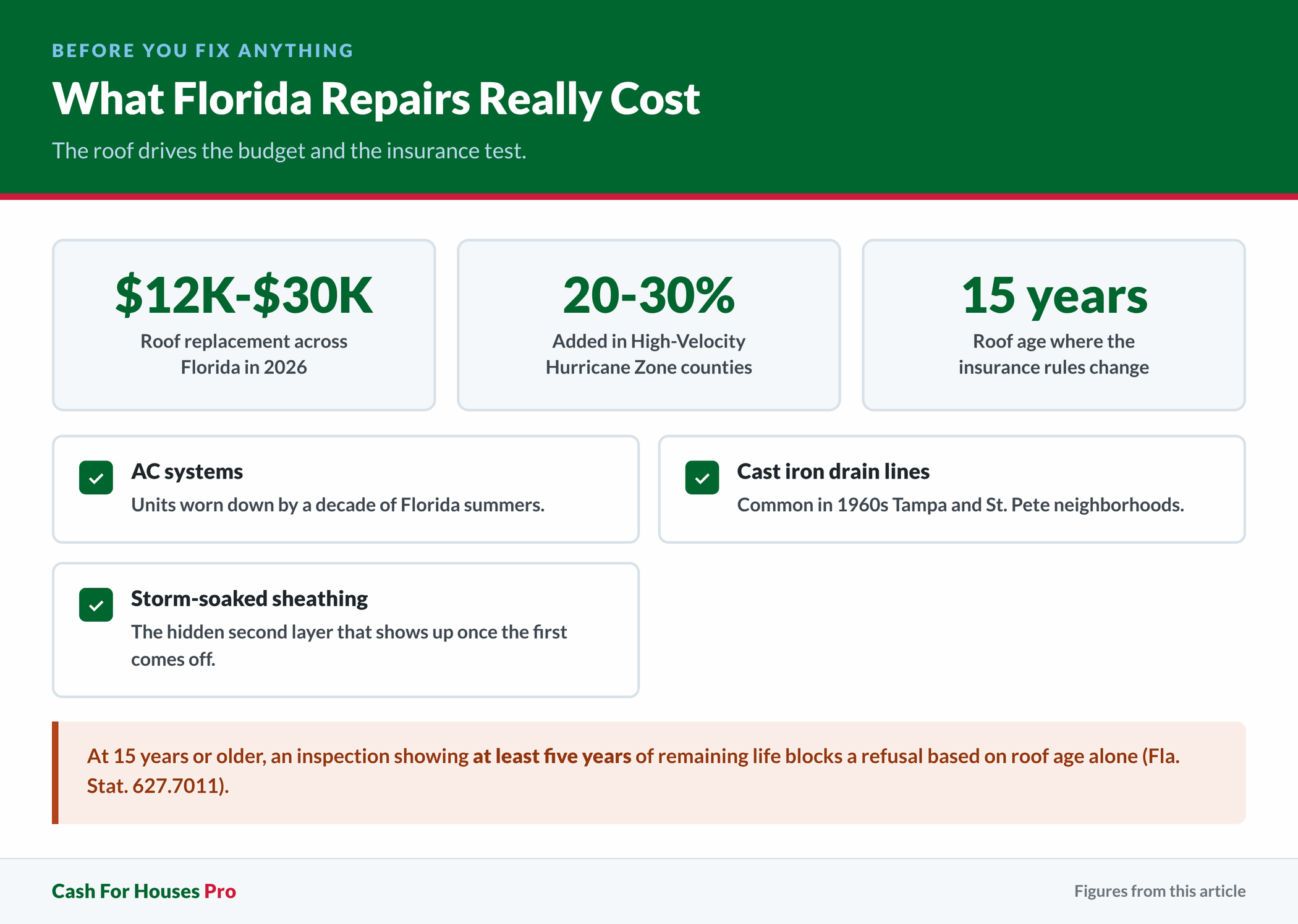
Roof replacement across Florida runs from roughly $12,000 to $30,000 as of 2026, and coastal counties push higher because of hurricane code. Miami-Dade and Broward sit inside the High-Velocity Hurricane Zone, so stricter code requirements and approved materials can add twenty to thirty percent to the bill. A Cape Coral bungalow and a Coral Gables ranch will never quote the same.
Insurance is the hidden multiplier on a Florida house that needs repairs. Under section 627.7011(5) of the Florida Statutes, an insurer can’t refuse to issue or renew a homeowners policy solely because of roof age while the roof is under 15 years old. At 15 years or older, an inspection showing at least five years of remaining useful life blocks a refusal based on age alone. Still, Citizens, the state-backed carrier, applies its own underwriting on top of that. You can read the statute language yourself at the Florida roof age rules breakdown.
Why should a seller care about that? Because your buyer’s lender needs the house insurable, and a Florida house that needs repairs to its roof can fail that test before anyone argues about price.
Beyond the roof, a Florida house tends to fail in the same predictable spots. So budget realistically for them: AC systems cooked by a decade of August, cast iron drain lines in 1960s Tampa and St. Pete neighborhoods, and sheathing that soaked up a storm. My repeated observation after years of buying here is that sellers underestimate the second layer of every job, the part you can’t see until the first layer comes off.
Should You Fix It or Sell the House That Needs Repairs As-is?
A while back, two adult children called me about their mother’s house in Lakeland, which was three months behind on the mortgage with an auction date already circled. The garage held forty years of fishing gear and a leaking water heater nobody wanted to touch.
They had quotes for about nineteen thousand in work and no way to pay for it before the sale date, so fixing wasn’t a choice; it was a fantasy with a deadline attached. We closed as-is, the arrears got paid, and the siblings split what was left.
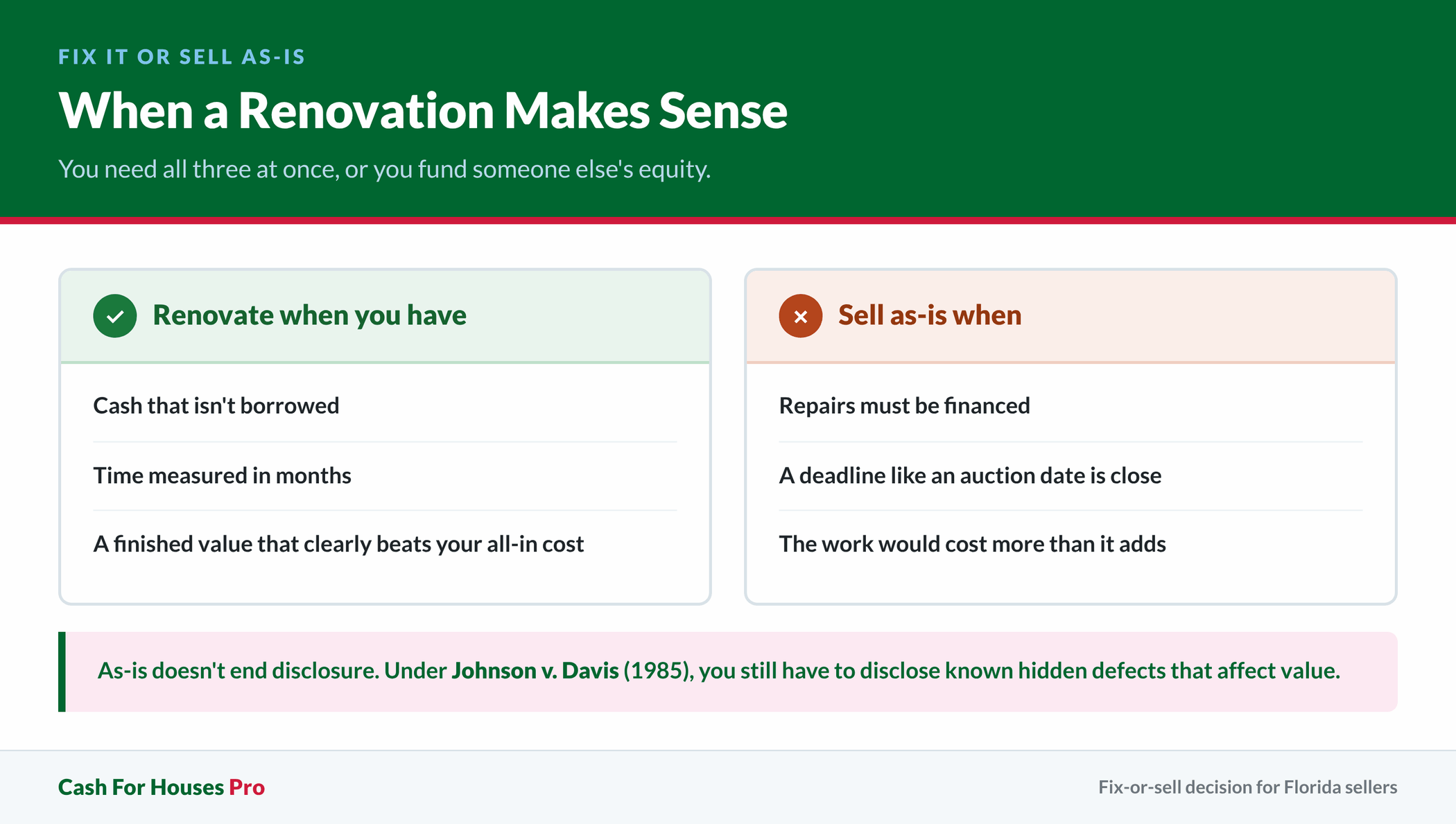
Renovation makes sense when you have three things at once: cash that isn’t borrowed, time measured in months, and a property where the finished value clearly exceeds your all-in cost. Miss any one of those, and you’re funding someone else’s equity.
Common advice says fix the kitchen first, but I disagree for most Florida sellers with a house that needs repairs. Buyers forgive a dated kitchen; appraisers and inspectors don’t forgive active water intrusion. Put a dollar toward the roof, the AC, or a plumbing failure before you touch cabinets.
Selling as-is doesn’t erase what you have to tell people. Under the 1985 Florida Supreme Court decision in Johnson v. Davis, a seller who knows facts materially affecting the property’s value that aren’t readily observable has a duty to disclose them, and an as-is contract doesn’t eliminate that obligation. The full explanation of Florida’s disclosure standard is worth twenty minutes of your time. An as-is clause in Florida means you won’t do the work, not that you get to stay quiet.
What’s a Fair Price for a Florida House That Needs Repairs?
A Sarasota seller listed at full retail with a thirty-year-old roof. Nine weeks later, two price cuts and one dead contract had taught him what a deduction looks like when the market applies it for you.
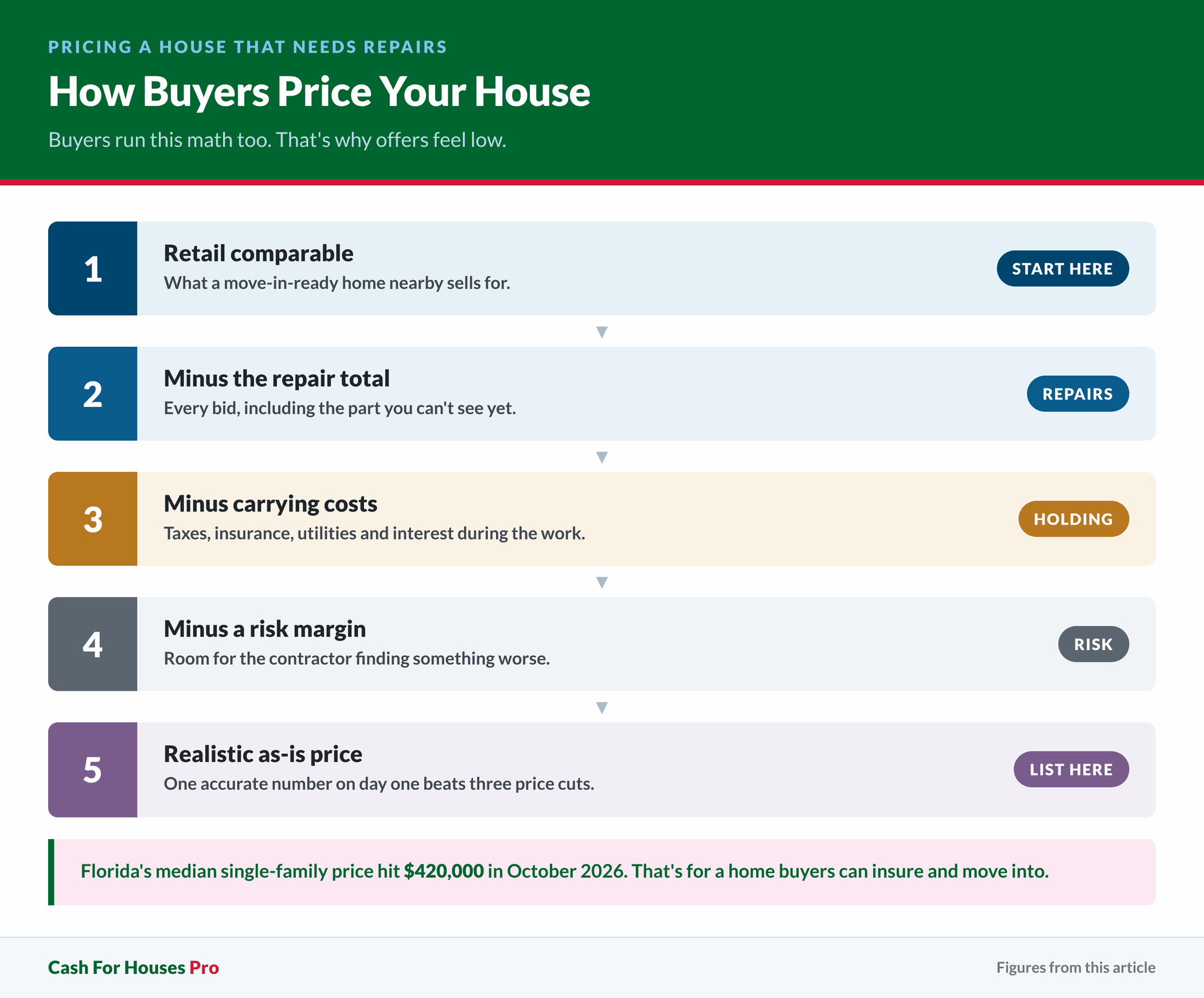
Pricing a Florida house that needs repairs starts with honest comparables, not with what the neighbor got. Florida’s median single-family price landed at $420,000 at the end of October 2026, a 2.2 percent increase year over year. That’s the number for a home somebody can insure and move into. Yours isn’t that home yet.
From the retail comp, subtract the repair total, then subtract the carrying costs during the work, then subtract a margin for the risk your contractor finds something worse. Buyers run this same arithmetic, which is why their offers feel low. They aren’t insulting you; they’re pricing uncertainty.
What moves the needle is local detail. Markets across the state move at different speeds. Orlando’s median single-family sale price was $441,500 in October 2026, and that gap against statewide numbers tells you a Winter Garden fixer and a Pensacola fixer live in separate worlds. Metro-level price data is free and takes five minutes to check.
What would you honestly pay for your own house if you had to fund every repair yourself? Most sellers who run that exercise end up within ten percent of the offers they’d been rejecting.
Where I see real money lost is on the second and third price reduction. Each one signals desperation and resets the clock. One accurate number on day one beats three corrections over four months.
What Are the Pros and Cons of Selling a House That Needs Repairs in Florida?
Agent commissions, title charges, and buyer concessions typically pull six to ten cents out of every dollar at a traditional Florida closing, and on a distressed property the concessions line grows after inspection. That cost rarely shows up in the fix-it-first pitch.
The upside of listing a Florida house that needs repairs with a real estate agent is reach. More eyeballs can mean competing offers, and a skilled REALTOR® with good marketing can find the rare retail buyer willing to take on a project. Some do exist, particularly in neighborhoods people love enough to tolerate a gut job.
Costs run the other direction. Showings with a failing AC in July are miserable. Financed buyers bring appraisers and underwriters who flag the same defects over and over, and FHA or VA financing tightens that further.
Selling as-is trades top-dollar potential for certainty.
You skip the renovation, the permit timeline, and the inspection renegotiation. What you give up is the premium a move-in-ready house earns, and anyone telling you otherwise is selling something. Florida sellers who need speed, privacy, or a clean exit from an inherited property usually find that trade worth making.
One more Florida wrinkle: condos and townhomes carry association assessments that can dwarf the repair list itself. Milestone inspections and reserve studies have reshaped pricing on older coastal buildings from Clearwater to Hollywood. A unit that needs repairs plus a pending structural assessment is a different animal than a single-family house that needs repairs, and it deserves its own conversation.
Who Buys Florida Houses That Need Repairs Without a Renovation?
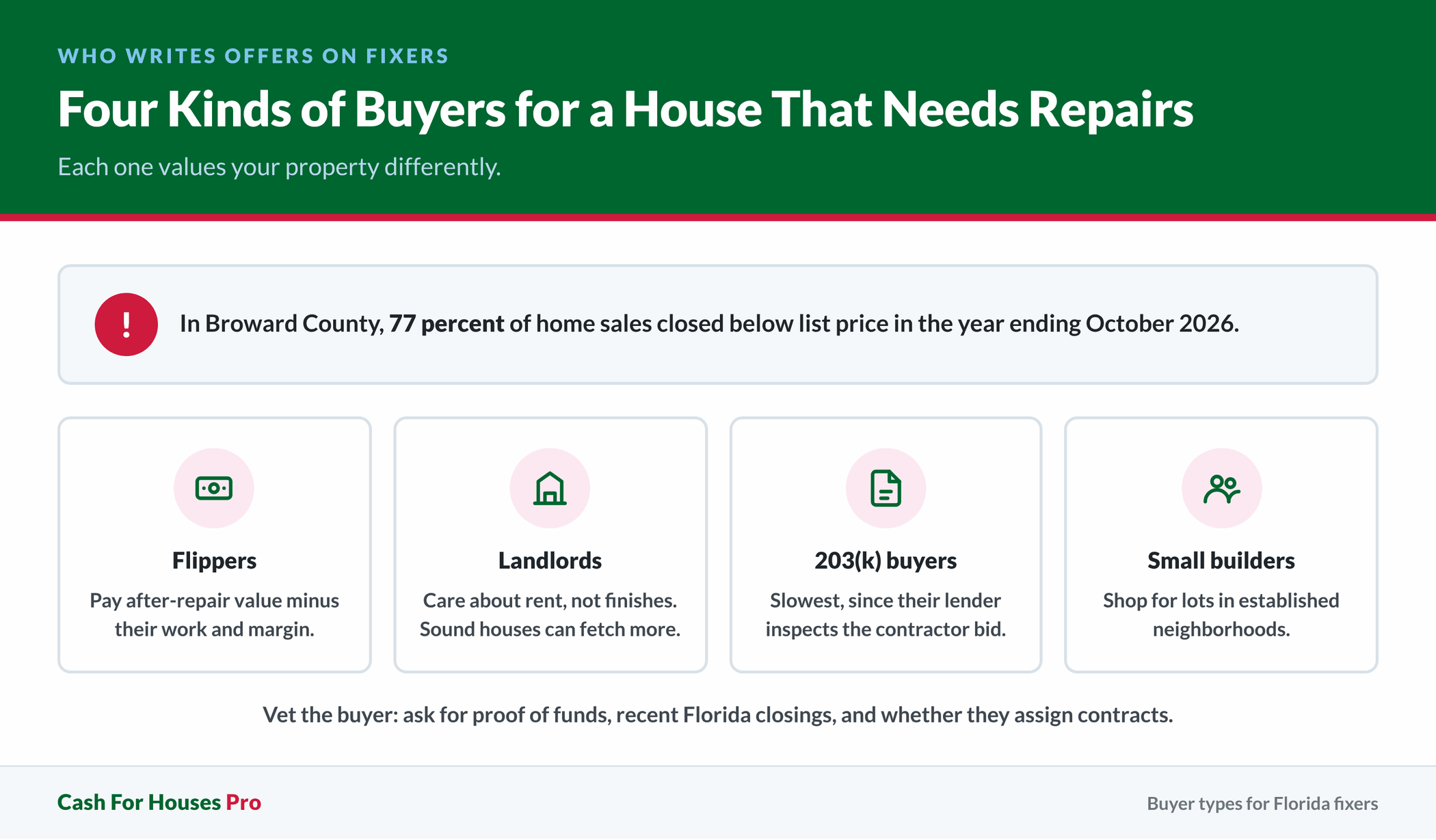
In Broward County, 77 percent of all home sales closed below list price over the twelve months ending in late October 2026. That’s the climate real estate investors are shopping in, and it shapes who’s writing offers on distressed property right now.
Four groups buy Florida houses that need repairs. Local real estate investors who flip, buy-and-hold landlords building rental portfolios, owner-occupant buyers with 203(k) renovation financing, and small builders looking for lots in established neighborhoods. Each one values your property differently.
Flippers pay based on after-repair value minus their work and margin. Landlords care about rent, not finishes, so a structurally sound house that needs repairs cosmetically can fetch more from them than from a flipper. Renovation-loan buyers move slowest because their lender inspects the contractor’s bid, not just the house.
Cash For Houses Pro works in this space across Florida and buys houses in their current condition, which spares you the inspection renegotiation entirely. Their team at cashforhousespro.com looks at properties other buyers skip.
You should vet buyers more than you chase the offer number. Ask for proof of funds, ask how many Florida closings they completed in the past year, and ask whether they assign contracts to someone else. An investor who intends to flip your contract will hedge on that last question every time.
How Do Negotiations Work When Your Florida House Needs Repairs?
Repair credits beat repairs, nearly always.
When a buyer’s home inspection comes back with a list, you have three moves: fix the items, credit money at closing, or hold your price and let them walk. Credits keep you out of the contractor scheduling nightmare and off the hook for warranty arguments later.
Florida’s standard contract gives buyers an inspection period during which they can cancel, and an as-is contract means the seller won’t fix things while the buyer retains the right to walk during that window. Knowing that changes how you respond to a demand letter. A buyer threatening to leave over a $400 item usually isn’t leaving.
Leverage follows the market. Statewide, Florida listings sat a median of 81 days in September 2026, second-longest in the country, which means buyers across the state have room to push. Sellers of a Florida house that needs repairs feel that pressure first and hardest.
Pick your defensible line before the inspection, not after. I decide in advance which items I’ll address and which I won’t, and the deals go smoother for it. Sellers who negotiate emotionally after reading a forty-page report almost always concede more than they planned.
Something buyers do that catches sellers flat: they’ll reprice the whole deal off one finding, so a single stucco crack becomes an argument about the entire envelope. Ask for the contractor estimate behind the number. Half the time it doesn’t exist.
Would you rather argue line items for three weeks or take a slightly lower number with no contingencies? There’s no universally right answer, but Florida sellers facing a deadline should know which one they’re choosing.
How Do You Sell a Florida House with Repairs Needed Quickly?
Miss the window and you’re paying another month of taxes, insurance, utilities, and interest on a house you don’t live in. Speed has real dollar value on a property that needs repairs, and most sellers price it at zero.
Fast Florida sales come down to three decisions made early. Price it where the condition actually sits, gather your documents before the offer arrives, and choose a buyer who doesn’t need a lender’s permission to close.
Paperwork delays kill more quick closings than price ever does. Pull your deed, your most recent tax bill, any permit records, and the death certificate or letters of administration if the property came through probate. Florida title companies will ask for all of it, and I’ve seen open permits on old work turn into a genuine headache in counties like Pinellas and Palm Beach.
A direct sale usually closes in one to three weeks because there’s no appraisal and no underwriting. Compare that against the median of 51 days to sell in Broward and 45 in Palm Beach between October 2025 and September 2026, then add thirty to forty-five days for a financed buyer’s closing. County-level MLS data backs that timeline up.
Cash For Houses Pro handles Florida properties on this kind of schedule, and getting a condition-based number from them costs you nothing even if you ultimately list with an estate agent instead.
A landlord in Ocala called me after two separate agent listings expired without a single offer. His tenant had left the place rough, the Florida room had a sagging ceiling, and he’d stopped driving past it on Sundays because it made him angry. Two REALTORS®, nine months total, zero contracts. Once it was priced for what it was, not what the comps suggested, the house sold in eleven days.
What Questions Do Florida Sellers Ask About Houses That Need Repairs?
“Won’t I get lowballed?” Fair worry. The protection is simple: get more than one offer, and compare net proceeds rather than headline price. A retail number minus commissions, concessions, and four more months of carrying costs often lands below a direct offer.
Florida sellers ask about taxes next. Prorated property taxes get settled at closing through the title company, and your county tax collector’s office can confirm exact figures for your parcel. Capital gains treatment depends on your own situation, so a CPA is the right call before you sign anything.
Buyers almost always ask a third question too: disclosure liability on a Florida house that needs repairs. Write down what you know, hand it over in writing, and keep a copy. Disclosure protects you far more than it costs you.
Sellers also want to know if an as-is sale looks bad to the neighbors or the county. It doesn’t. Property transfers in Florida are recorded the same way regardless of condition, and nothing in the public record flags a house that needs repairs as a distressed sale.
Frequently Asked Questions About Selling a House That Needs Repairs in Florida
Is It Hard to Sell a Florida House That Needs Repairs?
Harder than selling a renovated home, but not hard in any absolute sense. Your pool of financed buyers shrinks because lenders want insurable, habitable property, so you’re marketing mainly to investors and cash purchasers. Price it to condition and the interest shows up quickly; price it to the neighbor’s remodeled comp and you’ll sit.
How Long Am I Responsible for Repairs After Selling a Home in Florida?
An as-is sale ends your obligation to perform work at closing, but the Florida disclosure duty described earlier doesn’t vanish when the deed records. A buyer who later proves you knew about a hidden, material defect and said nothing can bring a nondisclosure claim. Timeframes for those claims are set by statute and depend on the specific claim, so a Florida real estate attorney is the right person to ask about your situation.
Can a Florida Seller Refuse to Make Repairs?
Yes. Nothing requires you to fix anything, and the standard Florida as-is contract is built around exactly that position. The buyer’s remedy is to cancel during the inspection period or to ask for a credit, and your remedy is to say no and move to the next offer.
Can I Sell My Florida House Without Doing Any Repairs at All?
You can, and plenty of Florida owners do it every week. Selling a house that needs repairs without lifting a hammer is a legitimate, common transaction, not a last resort. You trade some sale price for speed and certainty, you disclose what you know about the property, and you walk away without ever meeting a contractor.
Will a Low Appraisal Sink My Florida Sale?
Only if your buyer is borrowing. Appraisers in Florida flag deferred maintenance, active leaks, and missing safety items, and lenders then require those cured before funding. A cash buyer removes the appraisal from the equation entirely, which is why direct sales on a house that needs repairs close on schedule more often than financed ones.
If you own a Florida house that needs repairs and you’re weighing whether to fix it, list it, or sell it as it stands, we’re glad to talk it through with you. Tell us what’s going on with the property and what you’re hoping to walk away with, and we’ll give you a straight read on your options. No pressure, no obligation, and no hard feelings if you decide to call a contractor instead.
Selling a House That Needs Repairs in Tampa Bay
The repair questions in this guide come up all over Tampa Bay, from older Tampa and St. Pete neighborhoods to newer subdivisions. Florida Realtors data puts the Tampa-St. Petersburg-Clearwater single-family median at $405,495 for October 2026, up 1.6 percent from a year earlier. That number reflects homes buyers can move into. A house that needs repairs prices off it minus the work, so an honest as-is number matters here too.
Get a Straight Answer on Your Florida House That Needs Repairs
Wondering whether to fix it, list it, or sell it as-is? Contact Cash For Houses Pro and tell us about the house. We buy houses in their current condition, and we’ll give you an honest read on your options, even when that means calling a contractor instead. Use the form below to get started.