
A signed contract in Florida isn’t a finished sale until the inspection clock runs out. Offers with no contingencies change that math, and in my years buying houses, they’ve turned into one of the most misread tools in Florida real estate. Whether selling with no contingencies makes sense for you depends on what you’d give up for speed, and that answer is different for every house.
What Makes a Florida Real Estate Deal Contingent or Noncontingent?
Florida has no all-purpose seller disclosure form, though a separate flood disclosure has been required since October 2024. Your broader duty to disclose exists anyway. Under the 1985 Florida Supreme Court decision in Johnson v. Davis, Florida home sellers must disclose known facts that materially affect property value and aren’t readily observable to the buyer. That duty survives any contract structure you choose, including one with every condition stripped out.
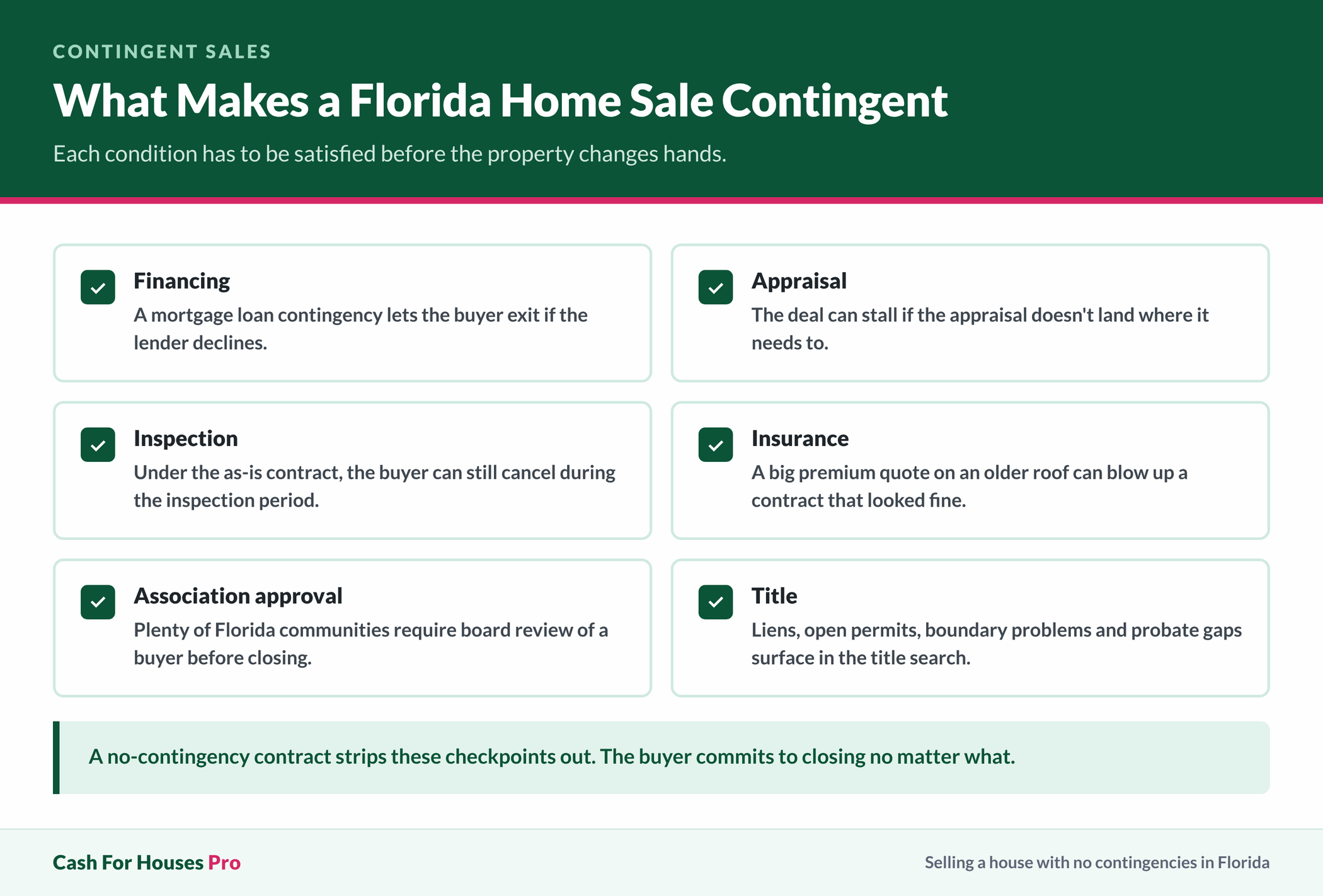
So what does “contingent” mean on a Florida listing? It means both signatures are on the contract and it’s legally binding, but only on a conditional basis. Each condition, whether it’s financing, an inspection or an appraisal, has to be met before the property changes hands. Insurance and the sale of the buyer’s current home can sit on that list too.
A contract with no contingencies strips those checkpoints out. The buyer commits to closing whatever the inspector finds or the appraisal says, even if a lender gets cold feet. Florida real estate contracts allow that structure. The parties can negotiate almost any condition they want, including dropping all of them.
Early last year I bought a house in Orlando from two adult children whose father had moved into assisted living. They’d watched two agent listings expire with nothing but a few lowball nibbles, mostly because the 1970s roof scared off every financed buyer. We closed with no conditions at all, and they finally stopped paying two sets of bills.
Contingent status also shows up differently in Florida MLS systems depending on the board. Some brokers mark a property “active with contract,” while others use “contingent” as a catch-all.
Contingent vs Pending: What’s the Difference in Florida?
Picture a buyer who still has conditions to clear before closing. Agents call that a contingent offer. Pending means the contract has cleared its hurdles. The file sits at the title company waiting on a closing date. In Florida real estate, “pending” usually signals the inspection period expired, the loan commitment came through and the appraisal landed where it needed to.
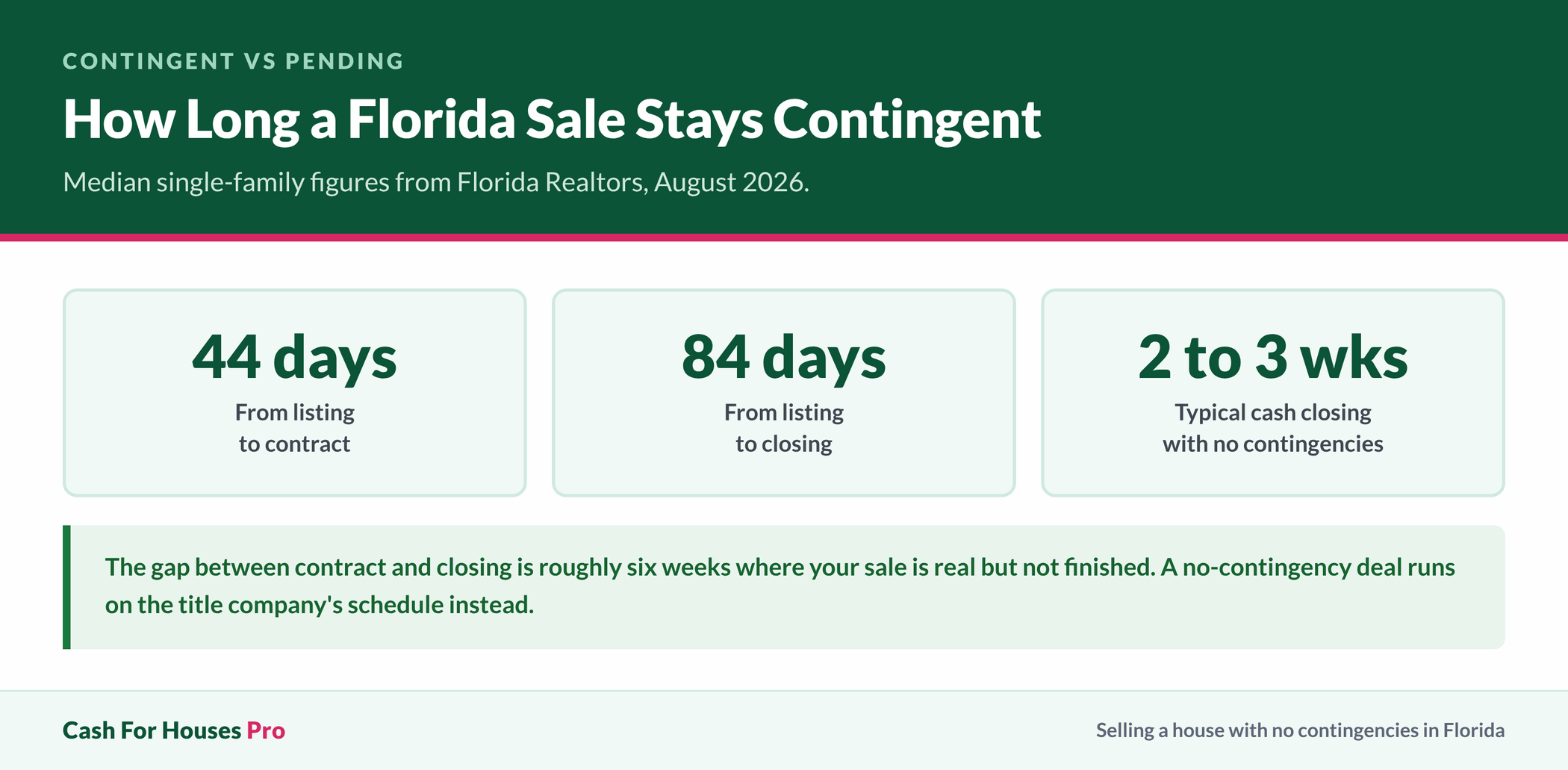
Watch the calendar. In August 2026 the median single-family home in Florida went under contract in 44 days and closed in 84 days from listing, according to Florida Realtors. Those roughly six weeks between the two numbers are the stretch where your sale is real but not finished.
Does that gap shrink when the buyer drops every condition? Yes, and that’s the whole appeal. Closings in Florida without them run on the title company’s schedule instead of an underwriter’s. In practice that means two to three weeks for most cash sales.
While you’re under contract, always accept backup offers, because a backup costs you nothing and saves weeks if the first buyer walks during the inspection window.
Pending status in Florida isn’t bulletproof either. Sales still collapse over last-minute title surprises or a buyer who changes jobs. Still, the failure rate drops hard once contingencies clear. That’s why serious cash buyers and companies like Cash for Houses Pro structure offers with no contingencies, since the whole point is skipping that fragile middle stage.
Can You Really Sell a House in Florida with No Contingencies?
“Can I actually find a buyer who can’t back out?” Yes, though with a caveat worth understanding.
Florida contract law lets a buyer waive inspection, financing and appraisal conditions. What the buyer can’t waive on your behalf is your disclosure duty. Even in an as-is sale, the seller still has to disclose known material defects.
In practice, only cash buyers make that kind of offer. A financed buyer can promise to close no matter what, yet if the lender says no, that buyer either brings cash or defaults. Most can’t. So when a Florida seller tells me they want an offer nobody can walk away from, what they really want is a buyer who doesn’t need a mortgage.
Investors write most of those offers. Retirees moving down from the Northeast with equity from a prior sale write plenty too. You’ll also see them from 1031 exchange buyers racing a tax deadline and from Florida homebuyers in hot price brackets.
Any buyer who takes on all the risk prices that risk in. You’ll see offers below retail, sometimes well below, mostly on houses with an old roof or deferred maintenance. I’ve watched sellers turn those down only to net less after months of carrying costs. Whether the discount is worth it depends on what the other path costs you in carrying expenses, repairs and months of showings.
For some Florida homeowners the math clearly favors listing. A clean, updated house in a good Sarasota or Winter Park neighborhood belongs on the MLS. An inherited property in Pensacola with a failing AC and a garage full of a lifetime’s belongings is a different story. Once you count everything there, a sale with no contingencies often nets more, and any buyer worth your time will put that math on paper with you.
Reputable Florida buyers require you to.
How Does the Inspection Period Affect Contingencies in Florida?
A Cape Coral landlord called me on a Thursday after his buyer’s inspector found active leaks under two bathroom vanities. By Friday the buyer had canceled, and the house went back on the market with nineteen days of market time already burned.
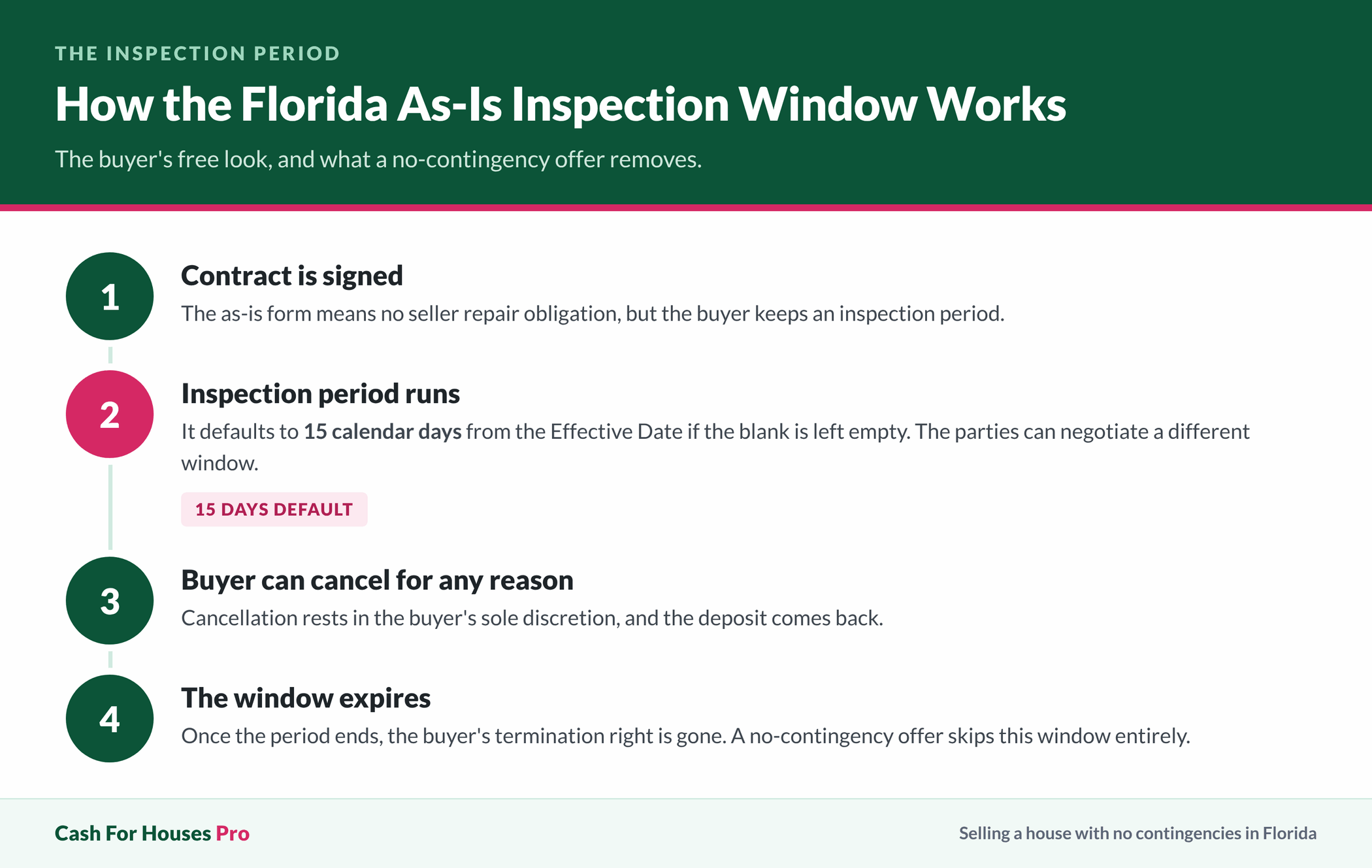
On the FR/BAR AS-IS form, the inspection period defaults to 15 days from the Effective Date when the blank is left empty. You and the buyer can negotiate a different window. Those are calendar days, so weekends count.
Buyers love this window because it’s so broad. The contract lets them cancel in their “sole discretion,” without pointing to a single defect. Even a spouse who hated the backyard is reason enough, and the deposit still comes back. From the buyer’s side I understand the appeal, since it works like a free option.
I understand why.
Selling with no contingencies removes this window, which is the single largest practical difference between the two structures. No report shows up with forty photos of normal wear presented as a catastrophe. You trade the chance at a higher price for the certainty that your buyer can’t renegotiate on day twelve.
A twenty-day window on a house with an aging roof is an invitation to a price reduction request. Between two similar offers, the shorter inspection period is usually worth more than a few thousand dollars in list price.
What Are the Risks of No Contingencies on a Florida Sale?
One condo sale in Tampa changed advice I’d given sellers for years. I used to say a sale with no contingencies carried almost zero downside for them, and that was sloppy.
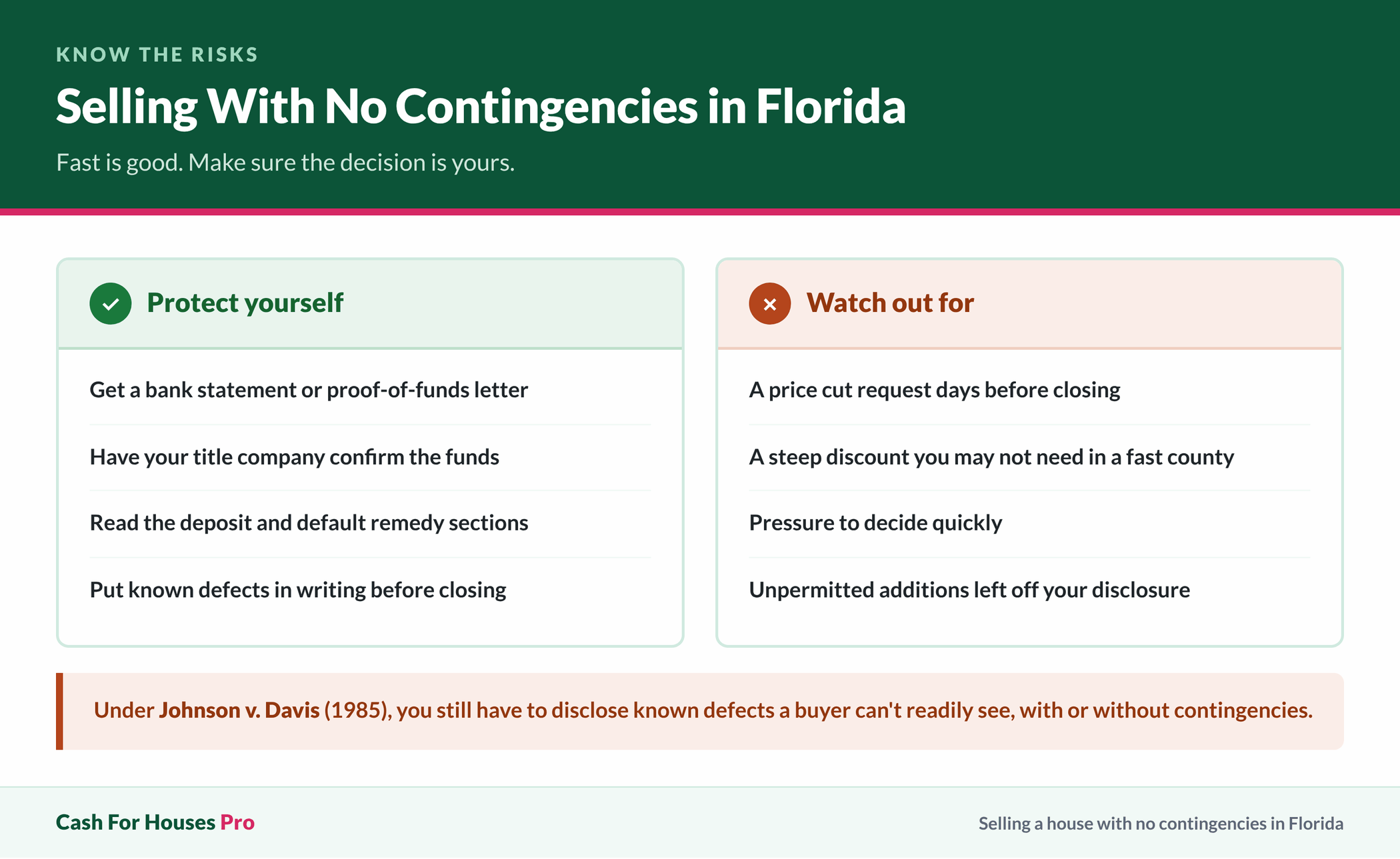
The real exposure comes from buyers who write offers with no contingencies and then try to renegotiate anyway, betting you’ve already spent the money in your head. Even someone with no contractual right to cut the price will sometimes ask for a cut three days before closing. Your protection is the deposit and a contract that spells out default remedies. Read those sections before you sign.
Your disclosure obligation doesn’t shrink either, though liability under Johnson v. Davis turns on actual knowledge. The seller has to know about the defect and has no duty to go looking for problems. Write down what you know about the roof, the plumbing and any past flooding. Add any work done without permits, since unpermitted work can create a disclosure problem of its own.
Underpricing is the risk I’d flag hardest for Florida sellers in strong submarkets. Palm Beach County single-family homes sold at a median price of $682,500 in October 2026, up 6.1% from a year earlier, with a median of 37 days on market. In a county moving that fast, taking a steep discount for speed you might not need is a bad trade.
Ask for a bank statement or a proof-of-funds letter from the buyer’s institution, and let your title company confirm it. Any legitimate Florida buyer hands that over without complaint.
Selling with no contingencies is fast, and fast means less time to second-guess. Make sure the decision is yours and not a response to pressure.
Do Buyers Have More Leverage When There Are No Contingencies?
Sitting at a kitchen table in Kissimmee last year, I told a seller what I’ll tell you now. A buyer who gives up every exit has handed you leverage, not taken it.
People hear “no contingencies” and picture a seller giving something away. The buyer has agreed to close without an inspector’s input, with no financing escape and no appraisal protection.
All of the risk moved to their column.
Comparing a cash number to the statewide median is where plenty of sellers go wrong. The median sale price for existing single-family homes in Florida was $415,000 in September 2026, up 1.2% from a year earlier. Before calling a cash offer a lowball, a seller should subtract commissions, repairs and carrying costs from that figure.
Ask two or three cash buyers for offers. Any Florida buyer who knows you’re shopping will sharpen their number. Anyone who refuses to compete usually wasn’t your strongest option, and serious buyers won’t mind the competition.
An owner in Palm Bay called me after a contractor handed her a kitchen renovation estimate bigger than what the finished kitchen would add to her sale price. Her cabinets had been water-damaged since a pipe let go the previous summer, and she’d been eating takeout for months. She sold with no contingencies instead, and the buyer gutted the kitchen anyway. Cash for Houses Pro see that situation all the time across Florida, and selling the problem is often cheaper than fixing it.
Frequently Asked Questions About Selling with No Contingencies in Florida
What Does “no Contingencies” Actually Mean in a Purchase Contract?
It means the buyer agreed to close with no condition that would let them cancel and recover their deposit. In Florida, a contract with no contingencies binds the buyer from the effective date forward. Their only outs are the seller’s failure to deliver clear title or to perform. That’s a far stronger commitment than a standard as-is contract, which still gives the buyer a free-look period.
Does Selling with No Contingencies in Florida Let Me Skip Disclosures?
No, and this is where sellers get into trouble. The duty to disclose known material defects a buyer couldn’t reasonably spot comes from Florida case law rather than your contract. If you know the roof leaks in heavy rain or there’s an unpermitted Florida room out back, put it in writing before closing. Buyers who close with no contingencies accept condition risk, not concealment.
Will I Get Less Money Selling with No Contingencies in Florida?
Usually, yes, on the headline number, though the net is what you’ll actually keep. On the listing side, subtract agent commissions and the repairs a financed buyer’s lender would demand. An insurance-driven roof replacement and a couple of months of mortgage, taxes and utilities come off that number too. Run both scenarios on paper before you decide.
How Fast Can a Florida Closing Happen with No Contingencies?
Once title is clear and funds are verified, most cash closings land on the timeline described above, sometimes sooner. Your title company’s search sets the pace, along with payoff letters on any existing mortgage and an HOA estoppel certificate if the property sits in an association. Probate or a messy title history will stretch things out no matter how the contract is written.
Can a Buyer Still Back Out of a Florida Contract with No Contingencies?
They can walk away, though not cleanly, because a buyer who defaults on a contract with no contingencies typically forfeits the escrow deposit. Depending on the agreement, the seller may have other remedies too. Deposit size matters for exactly that reason. Buyers who lowball the deposit are often the first to bail in my experience, so a larger deposit is worth asking for.
If a number like this is on your table for a Florida property and you aren’t sure it’s fair, I’m happy to look at it with you. We’ve bought enough houses across Florida to know when a cash sale makes sense and when a seller would do better listing. I’ll tell you which one I think you’re looking at. There’s no pressure either way, and no hard feelings if you go a different direction.
Ask Us About a Cash Offer With No Contingencies
If you’d like a firm number with no inspection period or financing clause attached, we’re happy to talk it through. We’ll explain how our offer works and how it compares to listing. Contact Cash for Houses Pro or use the form below whenever you’re ready.