
A landlord in Clearwater once told me he’d rather keep collecting $1,450 a month from a tired duplex than hand the IRS a check he hadn’t budgeted for. That instinct isn’t wrong. But staying put because you’re scared of a tax bill you’ve never calculated is a bad way to run a rental property, and Florida gives owners more exit options than most other states. Statewide, the median sale price sat at $421,500 in October 2026, with homes taking a median of 66 days to sell. It’s a real window to plan in.
What Is Capital Gains Tax on a Florida Rental Property?
Your gain isn’t what you think it is. Most owners calculate the sale price minus what they paid, then stop. The IRS doesn’t stop there, and neither should you, because every year you owned a rental property in Florida and claimed depreciation, you lowered your basis. Lower basis, bigger gain.
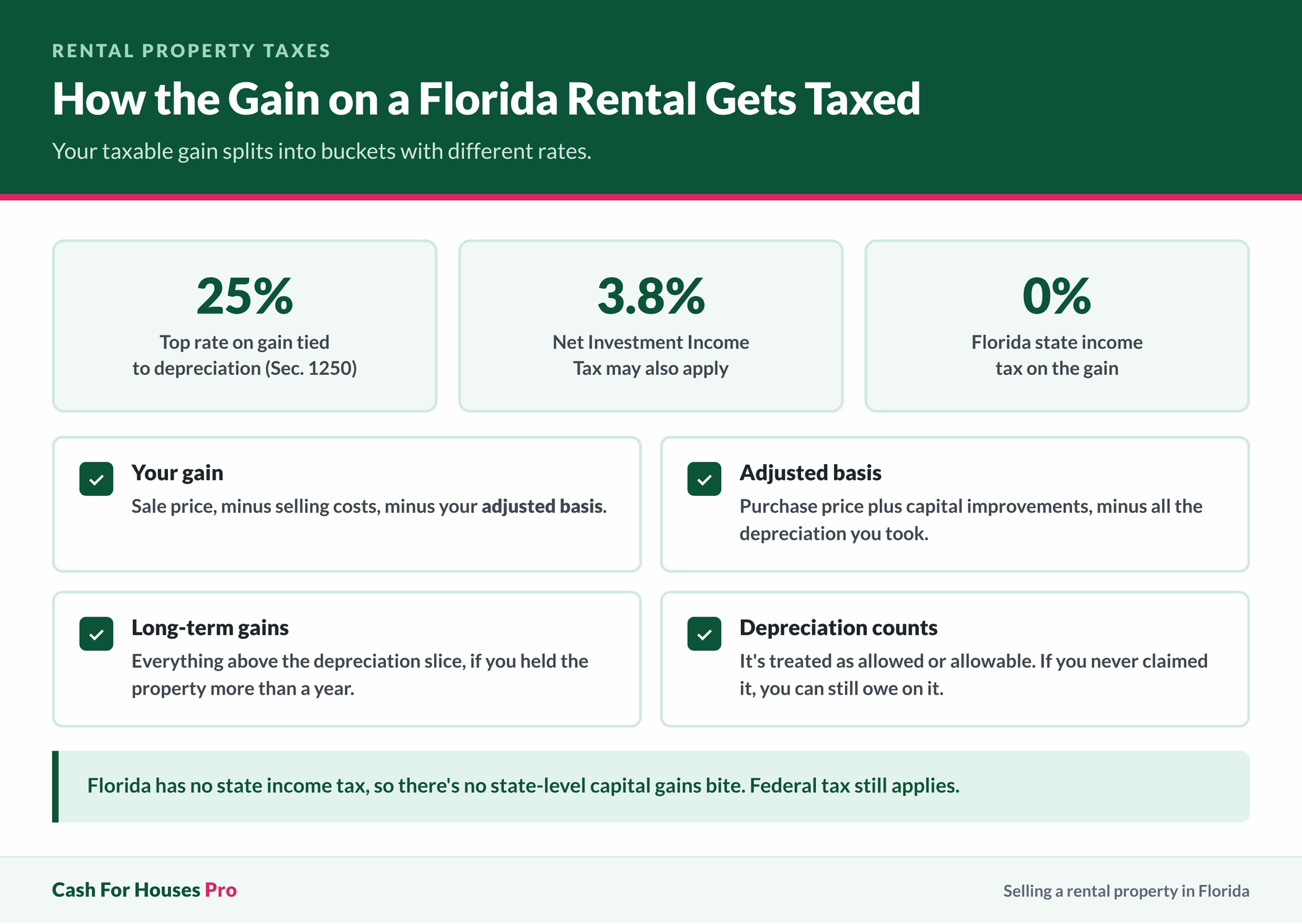
So the real math looks like this: sale price, minus selling costs, minus your adjusted basis. Your adjusted basis is the purchase price plus capital improvements (a new roof after a hurricane, a full kitchen rebuild) minus all that accumulated depreciation.
Then the gain splits into buckets with different price tags. The slice tied to depreciation gets its own treatment. The gain attributable to depreciation may hit the 25% unrecaptured Section 1250 gain rate. Taxable gain on the sale may also face the 3.8% Net Investment Income Tax. Everything above that is long-term capital gains if you held it more than a year.
Florida does add one piece of good news. No state income tax here means no state-level capital gains bite on your Florida property sale. An investor selling the same building in New York or California pays a second layer you simply don’t.
A few years back a young couple in Winter Garden called me about a three-bedroom their mother had just left behind when she moved into assisted living. They’d assumed the property would sell clean, no tax, because Florida has no income tax. Their CPA found eleven years of depreciation sitting on the Schedule E, and the recapture number changed their entire plan.
The biting piece is this one. Depreciation isn’t optional bookkeeping you can skip to avoid the bill later; the code treats it as allowed or allowable either way. If you never claimed it, you can still owe on it.
Can You Sell a Rental Property Without Paying Taxes in Florida?
“Can I just not pay it?”
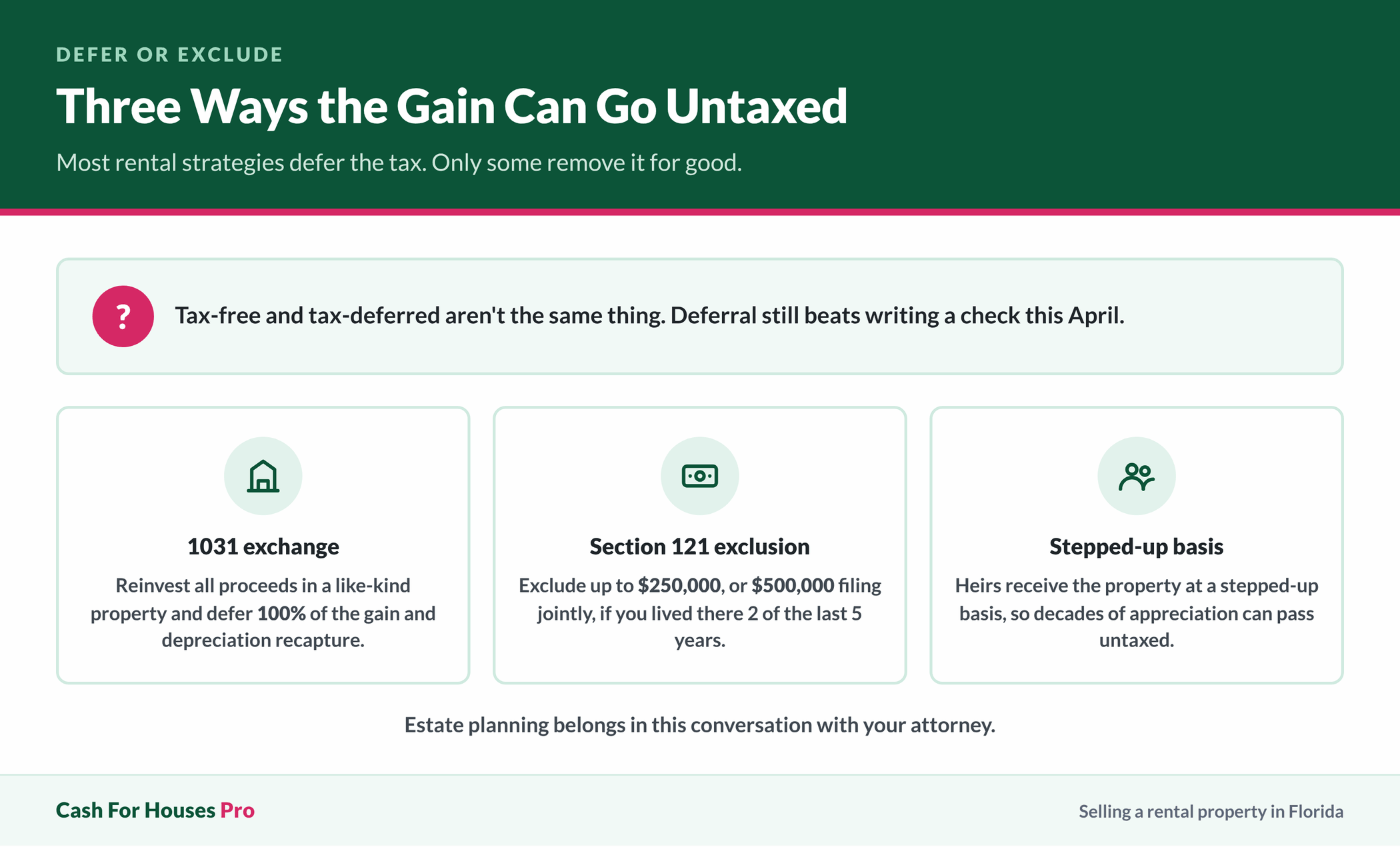
I hear a version of that question monthly. The real answer is that “tax-free” and “tax-deferred” are two different animals, and most Florida rental strategies deliver the second one. Deferral still beats writing a check this April. Permanent avoidance exists, but it comes with conditions you’ve got to engineer years ahead.
Section 1031 is the route to full deferral. Investors who reinvest all proceeds from an investment property sale into a like-kind replacement property can defer 100% of capital gains and depreciation recapture under IRC §1031. Nothing about Florida makes that harder or easier; the rules are federal.
Permanent exclusion works a different angle. Section 121 lets eligible owners exclude up to $250,000 of gain, or up to $500,000 filing jointly. This applies if they owned and used the home as a principal residence for at least two of the five years before the sale. It applies only if you lived in it during the right window.
Death resets everything, which is why some Florida landlords never sell at all.
Heirs receive property at stepped-up basis, which means decades of appreciation on a Tampa fourplex can pass without the gain ever being taxed. I don’t recommend building a life plan around dying at the right moment, but estate planning belongs in this conversation with your attorney.
What about selling at a loss, or offsetting gains with other investment losses? Capital losses elsewhere in your portfolio can soak up gain from a Florida property sale. Owners who hold multiple properties sometimes pair a winner with a loser in the same tax year on purpose.
Sellers underestimate how much timing matters. Statewide in September 2026, Florida listings took a median of 81 days and 20.1% carried a price cut. A sale that drifts past December 31 lands the whole gain in the following tax year, and that alone can change your bracket.
Which Strategies Help You Avoid Capital Gains Tax on Rental Property?
A Sarasota owner came to me holding a duplex with $190,000 of equity and a tenant who’d stopped paying, so we worked through an exchange from there. Six months later he owned two newer units near Lakewood Ranch and had deferred every dollar of gain.
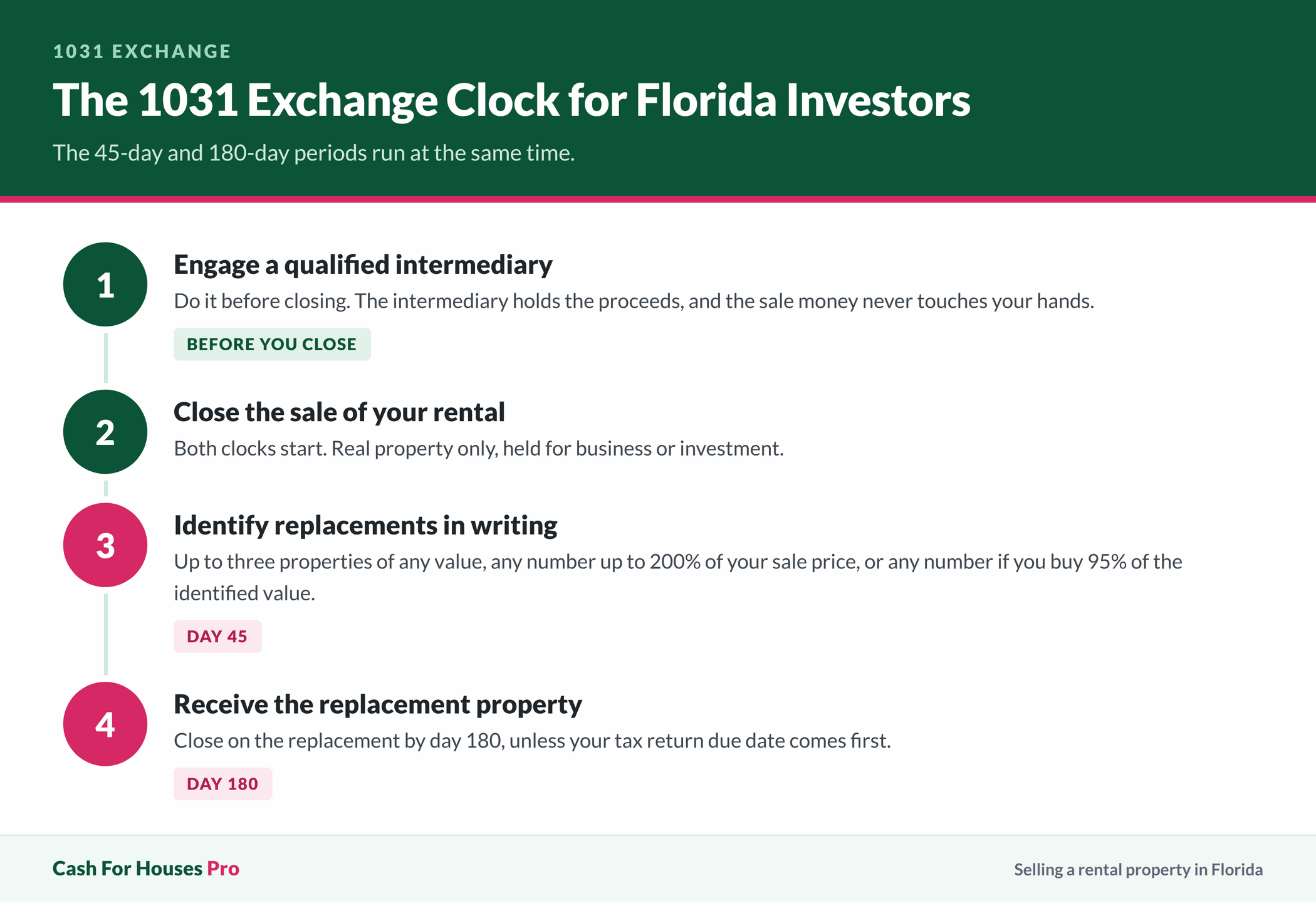
That’s the workhorse strategy for Florida investors. The core 1031 rules are real property only, held for business or investment, replacement identified within 45 days, closed within 180 days, and the sale money never touching your hands. A qualified intermediary holds the proceeds, and the 45-day and 180-day clocks run at the same time. Day 45 is the last day to identify in writing and day 180 is the last day to receive the replacement, unless your return due date comes first.
More Florida sellers get tripped up by identification rules than by the deadlines themselves. You can name up to three properties of any value, any number up to 200% of your sale price, or any number at all if you acquire at least 95% of the identified value. The detail on 1031 exchange requirements is worth reading before you sign a listing agreement, not after.
Converting it into your residence is the second real path. The exclusion requires two years of residence use within the five years ending on the sale date. An owner who lived in the home until converting keeps the exclusion for roughly three years of rental use. Snowbirds who moved into a Naples condo and rented the old Fort Myers house run this play constantly.
Watch the ordering, though. Under §121(b)(5), gain allocated to periods of nonqualified use after December 31, 2008 can’t be excluded, and the excludable share is the ratio of qualified-use time to total ownership time. Renting first and living there later costs you a chunk; living there first and renting later doesn’t.
Installment sales are the underrated option in Florida. Spreading your proceeds across several years keeps you out of the top bracket instead of stacking one enormous gain into a single return. So your tax hit shrinks each year instead of landing all at once. Seller financing on a Jacksonville rental can do that while producing monthly income at a better rate than a CD.
What Are the Pros and Cons of Each Tax-saving Strategy for Rental Property?
Which one fits depends almost entirely on whether you want to stay in real estate.
The 1031 is powerful and unforgiving. Miss a deadline and the exchange may be disqualified, with no grace period once the date passes. Florida’s inventory picture helps here: inventory rose to a 4.6-month supply in October 2026, the highest since May of that year. More listings means more realistic odds of identifying a replacement rental property inside the window.
But a 1031 chains you to landlording. If you’re exchanging into a property you don’t want just to dodge tax, you’ve made a bad investment with good tax treatment. I’ve watched sellers buy a Palm Bay rental property sight unseen on day 44 and regret it for years.
Residence conversion trades money for time. Two years of your life is the price, and you can’t collect rent during those years. For an owner already planning to relocate within Florida, that cost is close to zero; for an investor with a portfolio, it’s expensive.
Buyers take on risk with installment sales. You’re the bank now. If the buyer defaults on your Ocala rental property, you get the house back along with the headache, and the paperwork needs a Florida real estate attorney who’s drafted these before.
Then there’s the option nobody lists in tax articles: sell, pay the tax, and walk away clean. For a landlord in their seventies with a tired rental property and no desire to manage anything, writing one check and keeping the rest in cash is a perfectly rational outcome. Not every tax dollar is worth contorting your life to avoid.
Direct buyers fit that profile well. We work with sellers through Cash For Houses Pro who want a firm closing date they can hand to their CPA, especially when a tenant’s still in place and a retail listing would mean showings around someone else’s schedule.
What Mistakes Cost Florida Rental Property Sellers the Most Taxes?
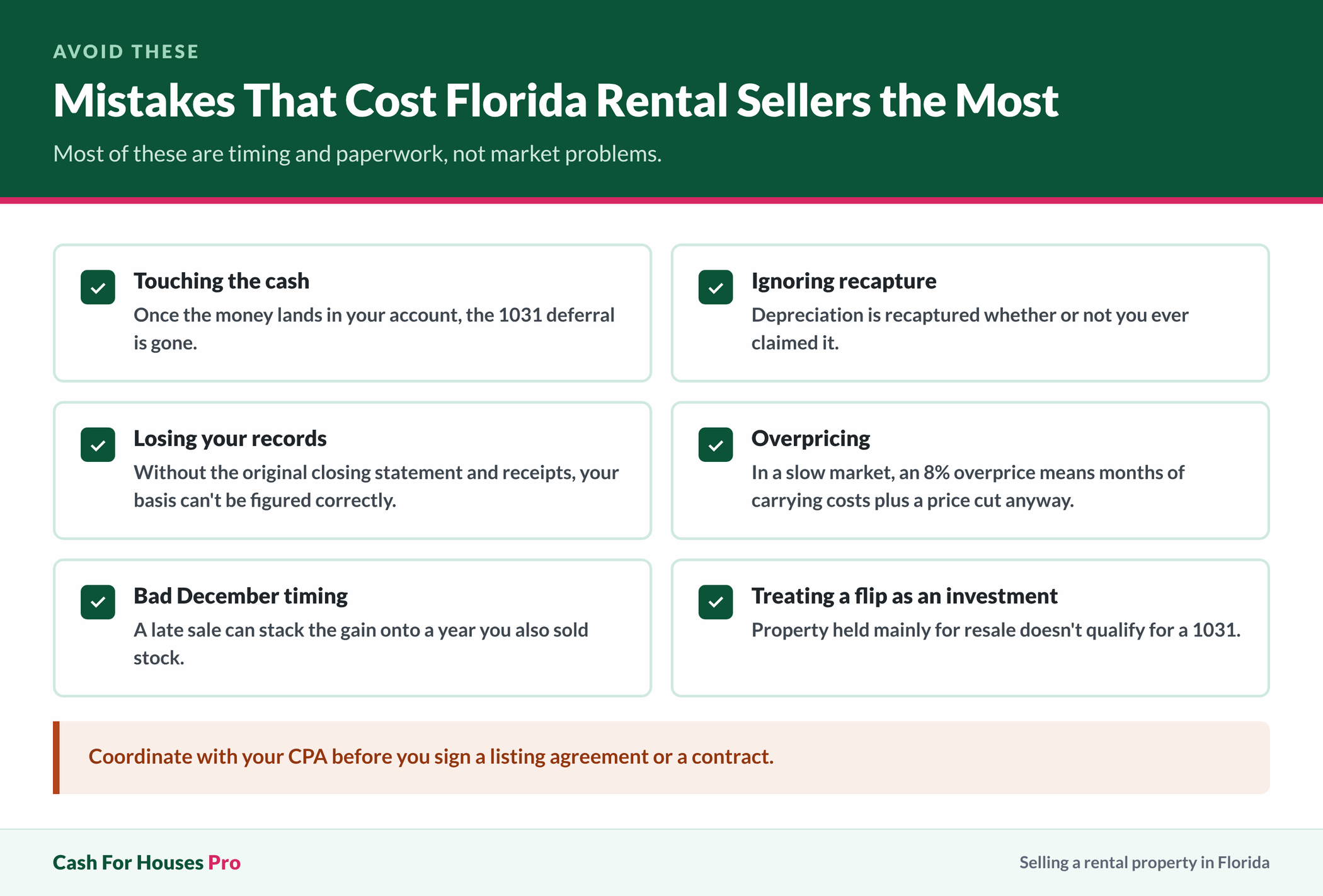
A Port St. Lucie landlord signed a contract on a Tuesday, closed three weeks later, and called an exchange company that Friday. The money was already in his account, and the deferral was gone.
That’s the costliest error I see. Touch the cash and the deferral is lost. Your intermediary must be engaged before closing, not after, and no Florida title company can unwind it for you later.
Mistake number two: forgetting that depreciation gets recaptured whether or not you claimed it. Owners who self-managed a small Florida rental property for fifteen years and never filed depreciation still owe on what was allowable.
Have you pulled your closing statement from the original purchase yet? Half the Florida landlords I meet can’t find it, and without it, nobody can compute your basis correctly. Capital improvements you paid for in 2014 vanish from the calculation when the receipts vanish, and you end up overpaying on a larger gain than you really had.
Pricing errors cost real money too. Florida’s median sale price ran $383,000 in October 2026, up 4.0% year over year, with 78 median days on market. Overpricing a rental property by 8% in a market moving that slowly means two months of carrying costs plus a price cut anyway.
Another one: sellers who dump a rental property in late December and discover the gain stacked onto a year when they also sold stock. Coordinate with your CPA before you sign.
Deferred maintenance gets mispriced in both directions. Some Florida owners spend $30,000 on renovations hoping for a higher sale price, then recover maybe half. Others ignore a roof that every inspector in Hillsborough County will flag. Neither approach is smart; get an honest read on what the repairs actually return in your submarket.
Last mistake worth naming: treating a flip as investment property. Primary residences, second homes used personally, and property held mainly for resale don’t qualify for a 1031.
What Does the Future Hold for Tax-free Rental Property Sales in Florida?
The exclusion figures haven’t moved since 1997. Those caps have never been indexed for inflation, and the One Big Beautiful Bill Act of 2025 left them untouched. A Florida rental property bought in 2010 near the beach can blow through a single filer’s cap on appreciation alone.
Meanwhile, you can still treat real estate as like-kind in 2026, and investors must still honor the 45-day and 180-day periods for deferred exchanges. Proposals to cap 1031 benefits surface in Washington every few years. None have passed, but an owner sitting on a large deferred gain should know that political risk exists.
Florida’s rental fundamentals are shifting underneath all of this. Condo owners feel it most: condo and townhome median prices came in at $290,000 in October 2026, down 3.3% from a year earlier, pressured by assessments and insurance. Single-family rentals in Central Florida have held up better.
Regional spreads are widening, which changes exchange strategy. Palm Beach County single-family homes posted a $682,500 median in October 2026, up 6.1%, moving in 37 median days. Trading a slow Panhandle rental property into a faster South Florida market is a legitimate move, assuming the rent math still works.
Insurance is the wildcard nobody can model cleanly. Premium increases have quietly erased cash flow on plenty of older Florida rental property holdings, and that’s pushing long-term landlords toward exits they weren’t planning five years ago.
A man called on a Wednesday afternoon from Deltona, job transfer to Charlotte, five weeks to be out. His rental property next door had a tenant on month-to-month and a garage full of his late father’s woodworking tools. We closed around the tenant and he kept the tools.
Plenty of Florida owners in that spot talk to Cash For Houses Pro simply because a certain closing date lets the rest of the plan work.
Frequently Asked Questions About Selling Rental Property Without Paying Taxes in Florida
Get the structure wrong and you can turn a deferrable gain into a taxable one with a single signature at the closing table. These are the questions Florida landlords ask me most.
Do You Pay Taxes When You Sell a House in Florida?
There’s no state income tax here, so Florida doesn’t take a cut of your gain the way most states do. Federal tax still applies, and on a rental property that means both the capital gains portion and the depreciation portion. You’ll also pay Florida’s documentary stamp tax on the deed at closing, which your title company handles; your county clerk’s office can confirm the current rate for your parcel.
What Is the Six-year Rule for Capital Gains Tax?
That one comes from Australian tax law, not the U.S. code, and it trips up plenty of people searching online. American owners work with the two-of-five-year ownership and use test described earlier in this article instead. If someone tells you a six-year window applies to your Florida rental property, they’re quoting the wrong country’s rules.
How Do You Avoid Capital Gains on a Rental Property?
The cleanest route is a like-kind exchange into another investment property, which defers the entire gain as long as you follow the identification and closing deadlines and never take possession of the proceeds. Moving into the rental property yourself for long enough to satisfy the residence test is the other main option, though the rental years still reduce what you can exclude. Installment sales and harvesting capital losses from other investments round out the realistic toolkit, and a Florida CPA should price each one against your actual numbers before you list.
Are Nonprofits Exempt From Property Taxes in Florida?
Florida does grant property tax exemptions to qualifying charitable, religious, educational and scientific organizations, but the exemption turns on how the property is used, not just who owns it. A nonprofit that holds a rental property as an income-producing investment generally doesn’t get a free pass on that parcel. Your county property appraiser’s office makes the determination and can tell you what documentation an application requires.
Can I Sell a Rental Property in Florida with a Tenant Still Living There?
You can, and investors do it constantly. The lease travels with the property, so the buyer inherits the tenant and the terms, which is exactly why occupied rentals often appeal more to other landlords than to retail buyers. If you need a vacant closing, build the notice period into your timeline before you accept an offer.
Does a 1031 Exchange Work If I’m Buying Outside Florida?
Yes. Any U.S. real property held for investment is like-kind to other U.S. real property, so a Tampa rental property can roll into a building in Georgia or Texas without breaking the exchange. Foreign real estate is the exception and won’t qualify.
If you’re weighing a sale and want to talk through what the numbers look like on your rental property, we’re happy to walk through it with you. Bring your closing statement and a rough depreciation figure, and we’ll tell you straight whether a traditional listing, an exchange, or a direct sale makes more sense for your situation. No pressure, no obligation, and if the answer is that you should hold the property another two years, we’ll say that too.
Talk With Us About Your Florida Rental Property
Weighing a 1031 exchange against a straight sale? Bring your numbers and we’ll walk through them with you. We buy rentals as-is, even with a tenant in place, and you pick the closing date that fits your CPA’s plan. Reach out to Cash For Houses Pro or fill out the short form below.